Trolling Depths for Landlocked Salmon
One of the most elusive challenges in targeting Landlocked Salmon in Maine is consistently finding them. You can have the perfect lure, the right boat speed, and be in a prime location like Sebago Lake or Moosehead, but if your offering isn't presented at the correct depth, you might as well be fishing in a bathtub. This guide is designed to peel back the layers of mystery surrounding effective trolling depths, helping you understand the "why" and "how" to put your presentation right in front of these magnificent fish.
Understanding Landlocked Salmon Behavior and Habitat
To consistently catch Landlocked Salmon, you first need to think like one. These fish are creatures of habit, driven by water temperature, available forage, and light conditions. Understanding these fundamental behaviors is the cornerstone of successful depth management.
Why Depth Matters for Salmon Anglers
Landlocked Salmon, as their name suggests, spend their entire lives in freshwater environments, unlike their sea-run Atlantic Salmon cousins. This means they are highly adapted to the specific conditions of Maine's deep, cold lakes. The primary driver for salmon depth preference is water temperature. They thrive in colder waters, typically between 45 to 55 degrees Fahrenheit. Anything much warmer can stress them, making them lethargic and less inclined to feed, while excessively cold water can also slow their metabolism.
Think about it from their perspective: if the surface water is too warm in the summer, they'll seek refuge in deeper, cooler strata. If their primary food source, like rainbow smelt, is concentrated at a certain depth, the salmon will follow. This constant vertical movement in search of comfort and calories means that static trolling at a single depth is often unproductive. Anglers who consistently vary their depth and understand these thermal and forage-driven movements are the ones who fill their creels. It's not just about getting the lure down; it's about getting it to the right down.
Preferred Water Temperatures and Oxygen Levels
The optimal temperature range for Landlocked Salmon is a critical piece of the puzzle. While they can tolerate a wider range, their metabolic activity, feeding behavior, and overall comfort peak within that 45-55°F sweet spot. In the spring and fall, these temperatures are often found closer to the surface or distributed throughout much of the water column. However, as summer progresses, a distinct thermocline often forms in deeper lakes.
The thermocline is a layer of water where the temperature changes rapidly with depth. Above it, the water is warmer; below it, it's colder. Salmon will often suspend right at or just below this thermocline, as it offers the perfect balance of cool water and often higher oxygen levels. Deeper still, beyond the thermocline, oxygen levels can drop in what's known as the hypolimnion, making these areas less habitable despite their cold temperatures. Therefore, successful summer trolling often involves meticulously locating this thermal sweet spot. Knowing How Deep Should You Troll for Salmon in Summer? becomes paramount to your success.
Forage Base Influence on Trolling Depths
Beyond temperature, the location of their primary food source is perhaps the most significant factor dictating where Landlocked Salmon will be. In many Maine lakes, the main course for these fish is the rainbow smelt. Smelt are schooling baitfish that also have preferred temperature ranges and will move vertically throughout the day and night.
When smelt are schooled up in a specific depth band, you can bet the salmon won't be far behind. Often, this means if you're marking schools of baitfish on your sonar, you should be concentrating your efforts at or slightly above or below those depths. It's not uncommon for salmon to hit lures presented just above a dense ball of bait, ambushing their prey from below. Conversely, sometimes they'll be found patrolling the edges or slightly below the main school, picking off stragglers. Understanding the Maine Smelt Run Timing can also give you clues about where the baitfish, and thus the salmon, might be concentrated during different parts of the year.
Seasonal Adjustments for Trolling Depths
The beauty of fishing for Landlocked Salmon in Maine is that the experience changes dramatically with the seasons. What works in spring won't necessarily work in summer, and fall brings its own unique set of challenges and rewards. Adjusting your trolling depths seasonally is not just a suggestion, it's a requirement for consistent success.
Spring Shallow Water Tactics
When the ice finally goes out on Maine's lakes, usually around April or early May, it's a glorious time for salmon anglers. The water is uniformly cold from top to bottom, and the fish are often found surprisingly shallow. During this post-ice-out period, Landlocked Salmon will cruise the upper water column, often within the top 10 to 20 feet, sometimes even right at the surface, especially during low light conditions or on overcast days. They're hungry after a long winter and actively chasing baitfish that are also moving shallow.
This is a prime time for using methods like flat-lining (trolling without added weight) or using small inline weights to get your lures just a few feet down. Long monofilament or fluorocarbon leaders are often effective, mimicking natural bait. Focus your efforts near shorelines, points, and coves where baitfish are congregating and the water might warm up slightly faster. Early mornings and late evenings are particularly productive, but even midday can be fruitful if the conditions are right. This period offers some of the best opportunities to catch actively feeding salmon without needing complex gear, making it a favorite for many anglers eager to get out on the water.
Summer Thermocline Dominance
As Maine transitions into summer, typically from late June through August, the game changes dramatically. The surface waters warm considerably, pushing Landlocked Salmon into deeper, cooler havens. This is when the thermocline becomes your best friend and your biggest challenge. Salmon will typically orient themselves along this thermal barrier, often in depths ranging from 25 to 60 feet, sometimes even deeper in very large, deep lakes like Moosehead or Sebago Lake.
Locating the thermocline is crucial. Modern fish finders are invaluable for this, often displaying a distinct layer where temperatures abruptly shift. Your goal is to troll your lures right at, just above, or just below this layer. This usually requires specialized gear like downriggers, lead core line, or dipsy divers to precisely present your baits at these significant depths. The fish are often more lethargic in the summer heat, so slower trolling speeds and subtle lure actions can be more effective. Concentrating on deeper points, humps, and the main lake basin becomes essential as the salmon seek thermal refuge. For a deeper dive, check out our guide on Maine Summer Fishing Guide.
Fall Spawning Runs
The arrival of fall brings another exciting shift in Landlocked Salmon behavior and, consequently, trolling depths. As water temperatures begin to cool significantly, mimicking spring conditions, salmon start to stage for their spawning runs, typically from late September into November. During this time, they become more active and aggressive, moving into shallower waters, especially near river mouths, tributary inlets, and rocky shoals where they will eventually spawn.
While they may not be feeding as actively on traditional forage as in the spring, their territorial instincts and aggressive nature make them responsive to lures. Trolling depths can vary, but often they'll be found in the 10 to 30-foot range, though they might make quick forays shallower. Focus on areas with current or rocky structure. Spoons and stickbaits that imitate stressed baitfish can be particularly effective. This is a fantastic time for larger, more vibrant lures, as salmon are looking to assert dominance and protect their spawning grounds. For an exhaustive resource, our Maine Fall Fishing Guide provides additional tactical insights.
| Season | Typical Trolling Depth (feet) | Key Factors Influencing Depth | Recommended Gear |
|---|---|---|---|
| Spring | 5 – 25 | Cold water throughout, active fish, bait shallow | Flat-line, inline weights, light lead core |
| Summer | 25 – 60+ (at/near thermocline) | Warm surface water, thermocline, low oxygen deep | Downriggers, heavy lead core, dipsy divers |
| Fall | 10 – 30 (near spawning areas) | Cooling water, pre-spawn aggression, bait shallow | Flat-line, inline weights, medium lead core |
| Winter (Ice) | 10 – 40+ (varies by bait/structure) | Stable cold water, bait location, structure | Tip-ups, jigging, specialized ice fishing gear |
Mastering Your Gear for Precision Trolling
Achieving precise trolling depths for Landlocked Salmon isn't just about guessing; it's about employing the right tools for the job. Different gear options allow you to target specific depths with varying degrees of accuracy and flexibility. Understanding how each works is key to becoming a proficient salmon angler.
Downriggers and Dipsy Divers
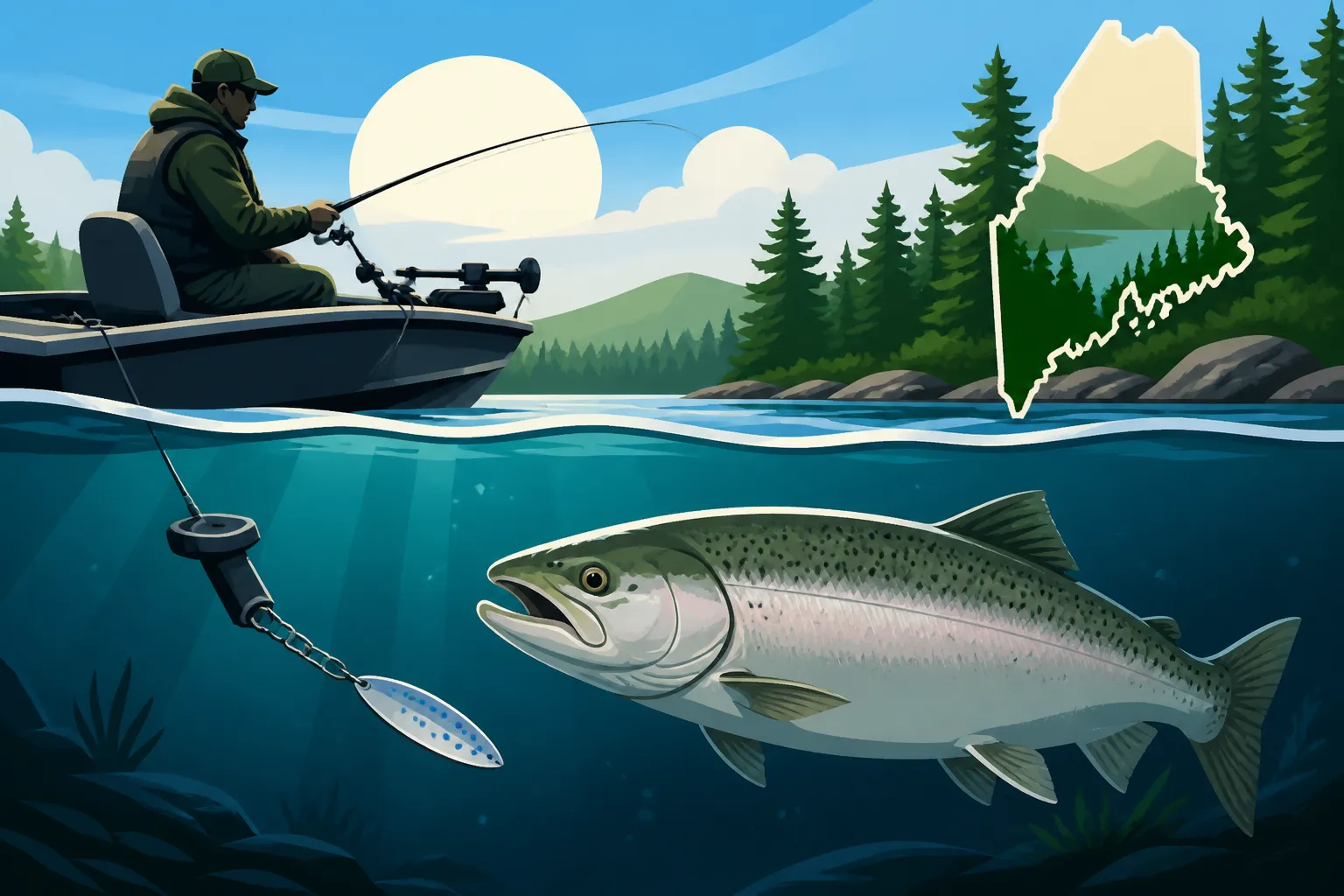
For pinpoint accuracy in deeper water, especially during the summer months when salmon hug the thermocline, downriggers are king. A downrigger is essentially a small winch with a heavy cannonball weight (often 8-12 lbs) on a cable. Your fishing line, with its lure, is clipped to the downrigger cable with a release clip. The downrigger weight pulls your line down to a precise depth, which is usually indicated on the downrigger's counter. When a fish strikes, the line pops free from the clip, allowing you to fight the fish directly without the weight. Brands like Scotty and Cannon offer reliable options for those looking to invest, often available on Amazon.
Dipsy divers (sometimes called directional planers) offer another way to achieve depth, particularly useful for getting lures away from the boat and down to 20-60 feet, depending on size and speed. These disc-shaped devices dive when trolled and can be set to "trip" when a fish strikes, allowing you to reel in the fish without the resistance of the diver. They also have an adjustable rudder that allows you to steer your lure out to the sides, covering a wider swath of water. While not as precise as downriggers for exact depth, dipsy divers are more portable and require less boat modification, making them a great choice for many anglers targeting Maine Lake Fishing Guides.
Lead Core Line and Planer Boards
Lead core line is a multi-colored line where each color (typically 10 yards) represents approximately 5 feet of depth at a standard trolling speed (around 2-2.5 mph) with a small lure. So, if you let out five colors, you're roughly 25 feet deep. It's a fantastic, low-tech way to cover a range of depths without requiring heavy boat modifications. The beauty of lead core is its simplicity and effectiveness across various conditions. For example, if you're exploring Trolling Depths for Landlocked Salmon in varied conditions, lead core allows for quick depth adjustments by simply letting out or reeling in more line.
Planer boards, on the other hand, are designed to spread your lines out to the sides of the boat, presenting lures in undisturbed water and covering a much wider area. While they don't directly achieve depth, they are often used in conjunction with other depth-controlling methods like lead core, downriggers, or dipsy divers. By getting your lures far away from the boat, you can target shy fish that might be spooked by the boat's presence. There are various types, from small inline boards to large mast systems, each with its advantages for different fishing styles. Using a combination of lead core and planer boards is a classic tactic for covering expansive waters like the Belgrade Lakes. You can find quality lead core line and a range of planer board options on Amazon.
Lure Selection and Action at Depth
The type of lure you choose plays a significant role not only in attracting salmon but also in achieving and maintaining your desired trolling depth. Heavy spoons or diving crankbaits will naturally run deeper than lighter, smaller offerings. However, a lure's action at depth is just as critical. A lure designed to wobble enticingly at the surface might lose its appeal when pulled through dense water at 40 feet.
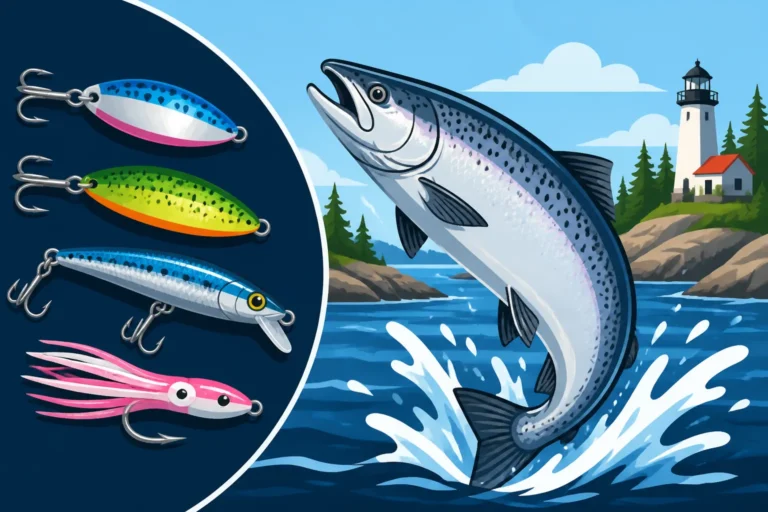
When selecting lures for deeper trolling, consider their inherent diving capabilities. Many crankbaits have large lips designed to get them down to specific depths. For spoons and stickbaits used with downriggers or lead core, focus on those that maintain a consistent, fish-attracting action at various speeds. Common and effective lures for Landlocked Salmon include various sizes of spoons (like Mooselook Wobblers, Suttons, or smaller DB Smelt), stickbaits (such as Rapala or Bomber long A's), and sewn bait rigs (like those using a real smelt or shiner). Experimentation is key, as salmon can be surprisingly particular. You can explore a wide variety of these lures, often with customer reviews indicating their effectiveness, on Amazon. Our guide on Best Lures for Maine Open Water Fishing offers more specific recommendations.
Advanced Strategies for Challenging Conditions
Fishing for Landlocked Salmon in Maine isn't always easy. There will be days when the fish seem to have lockjaw, or conditions make it difficult to get your lures in front of them. This is where advanced strategies come into play, helping you adapt and increase your chances of success even when the going gets tough.
Speed and Direction Adjustments
The "S" word—speed—is often underestimated in its influence on trolling depth and lure action. Every lure has an optimal speed range where it exhibits its most enticing action. Too slow, and it might just drag; too fast, and it might spin unnaturally or blow out. Furthermore, speed directly impacts how deep your gear runs. Increasing your speed will generally lift your lures slightly, while slowing down will allow them to sink deeper. This dynamic relationship means you can fine-tune your depth by adjusting your boat speed in conjunction with your depth-controlling gear.
Directional changes are another powerful, yet often overlooked, strategy. When you make a turn with your boat, the lures on the inside of the turn will slow down and sink, while those on the outside will speed up and rise. This subtle change in depth and action can often trigger strikes from otherwise lethargic salmon. Experiment with S-curves, figure-eights, or wide turns to present your lures at slightly varying depths and speeds within the same pass. Sometimes that momentary flutter or drop is all it takes to entice a following fish.
Trolling Patterns and Structure
Merely trolling in a straight line across open water can be effective, but often, the most productive strategy involves actively working specific underwater structure. Landlocked Salmon, especially when not actively chasing large schools of bait, will often relate to features like points, humps, drop-offs, submerged islands, and even old river channels. These structures provide ambush points, areas of varied current, or concentrated baitfish.
Develop a trolling pattern that systematically covers these structural elements. Instead of just going over a hump, troll around its edges, making sure your lures pass through different depth zones. If you mark a group of fish or bait on your sonar at a particular depth, make repeated passes through that area. Use your GPS to mark successful spots and replicate your trolling paths. Vary the distance your lures are behind the boat; sometimes a longer lead is better in clear water, while a shorter one can be effective when fish are concentrated or less wary. This mindful approach to Trolling Techniques for Maine Lakes transforms casual trolling into a highly strategic endeavor.
Targeting Specific Lakes and Their Nuances
While general principles apply, each of Maine's prominent salmon lakes has its own unique character and, therefore, nuances in optimal trolling depths.
- Sebago Lake: Known for its deep, clear waters, Sebago can hold salmon at considerable depths, especially in summer. The "Big Bay" and areas around Fryes Leap are popular. You'll often be targeting fish in the 30-60 foot range here during the warm months, focusing on the thermocline.
- Moosehead Lake: As Maine's largest lake, Moosehead offers vast areas for salmon. Fish can be found near the many islands, long points, and deep basins. Depths here can vary widely, but often 20-50 feet is productive, depending on the season and specific location. Early spring sees them shallower around places like Lily Bay. Check out our detailed Moosehead Lake Fishing Guide for more specific insights.
- Rangeley Lakes: This interconnected chain of lakes, including Rangeley, Mooselookmeguntic, and Aziscohos, are renowned for their cold, productive waters. Salmon here might hold slightly shallower than in Sebago, often in the 15-40 foot range, due to the excellent cold water habitat and abundant smelt populations. These lakes are especially good for early season and fall trolling.
- West Grand Lake: Located in Washington County, West Grand is another traditional Landlocked Salmon stronghold. Its significant depth and rocky structure often mean targeting salmon in the 20-50 foot range during summer, similar to Sebago, with shallower presentations in spring and fall.
Always consult the Maine Department of Inland Fisheries and Wildlife (MDIFW) regulations for specific lake rules, as special regulations can apply to Landlocked Salmon Size and Bag Limits in Maine for individual bodies of water.
Reading the Water: Electronics and Environmental Cues
Modern electronics have revolutionized how we approach fishing, providing invaluable insights into what's happening beneath the surface. However, combining these technological aids with traditional environmental observation creates the most potent strategy for pinpointing Landlocked Salmon.
Using Sonar and GPS Effectively
Your sonar (fish finder) is arguably the most important piece of equipment for determining trolling depths. It allows you to visualize the underwater world, showing depth contours, bottom structure, baitfish schools, and even individual game fish. For salmon fishing, pay close attention to:
- Bottom Contour: Look for changes in depth, humps, drop-offs, and submerged points. These are natural congregating areas for bait and salmon.
- Thermocline: On many modern units, the thermocline will appear as a distinct horizontal line or fuzzy band where the water temperature gradient is steepest. This is a crucial depth to target in summer.
- Baitfish Schools: Dense clouds or balls of baitfish (smelt) are like neon signs pointing to where salmon will be. Adjust your trolling depth to pass right through or near these schools.
- Individual Fish Marks: Salmon often appear as distinct arches on your sonar. If you see consistent marks at a particular depth, that's your target zone.
A good GPS unit, integrated with your sonar, allows you to mark waypoints for fish sightings, structure, and successful trolling paths. This helps you return to productive areas and refine your patterns over time. Understanding Reading a Fish Finder on Maine Lakes can give you a significant advantage.
Interpreting Water Temperature
While your fish finder gives you a visual representation, a good water temperature gauge provides crucial numerical data. Many modern sonars include a transducer with a temperature sensor, giving you real-time surface temperature. Some advanced units, or separate probes, can even give you a temperature profile of the water column, confirming the depth of the thermocline.
As discussed, Landlocked Salmon have a preferred temperature range. Constantly monitoring the surface temperature, and estimating or directly measuring subsurface temperatures, helps you predict where salmon might be holding. If the surface is 65°F, you know they won't be there, and you'll need to go deeper to find that 45-55°F sweet spot. In spring and fall, when surface temperatures are closer to their ideal, you can afford to fish shallower. This constant awareness of Reading Water Temperature for Maine Trout (and salmon!) is an environmental cue that guides your depth selection.
Reading Current and Wind Patterns
While less pronounced in lakes compared to rivers, current and wind still play a role in influencing salmon behavior and, indirectly, your trolling depth.
- Current: In large lakes, particularly near inflows (rivers) or constrictions, subtle currents can exist. These currents often concentrate baitfish, which in turn attract salmon. Trolling with or against the current can also affect your lure's action and effective depth. Trolling against a current might make your lure run slightly shallower and give it more action at a slower boat speed, while trolling with it might require more speed to achieve the same action.
- Wind: Wind creates surface chop and can also push surface waters, affecting baitfish distribution. On windy days, salmon might move to the lee side of islands or points to escape the turbulence. The chop on the surface can also make fish less wary of your boat and lures, sometimes allowing for shallower presentations. However, strong winds can make precise depth control challenging, especially with lighter tackle or lead core. Adjusting your boat's drift or using a trolling motor to maintain a consistent speed and line angle becomes paramount.
Safety and Conservation While Trolling for Salmon
Fishing in Maine, especially on its larger lakes, demands respect for both the environment and the fish you pursue. Responsible angling ensures that Landlocked Salmon populations remain healthy for future generations and that everyone on the water stays safe.
Best Practices for Catch and Release
While catching Landlocked Salmon for the table is a cherished tradition, practicing proper catch and release for fish you don't intend to keep is vital, especially for larger breeding fish or when targeting specific limits. When releasing salmon:
- Minimize Fight Time: Use appropriate tackle that can bring the fish to the boat efficiently without overly exhausting it.
- Handle Gently: Keep the fish in the water as much as possible. If you must lift it, support its body horizontally with both hands, avoiding squeezing its belly or gills. Avoid touching the gills or eyes.
- Remove Hook Quickly: Use needle-nose pliers or a hook remover to quickly extract the hook. If the fish is deeply hooked, cut the line as close to the hook as possible.
- Revive Properly: Hold the fish gently in the water, facing into any current, until it can swim away under its own power. Don't simply toss it back; ensure it's strong enough to orient itself and swim off.
These practices, crucial for all species, are particularly important for salmon. Our guide on Catch and Release Best Practices in Maine offers even more detailed advice to ensure the health of our fisheries.
Responsible Angling and Regulations
Every angler venturing onto Maine's waters has a responsibility to know and abide by the state's fishing regulations. These rules are designed to protect fish populations and their habitats. For Landlocked Salmon, this includes:
- Maine Fishing License Guide: Always ensure you have a valid Maine Fishing License Guide before casting a line. Licenses can be easily purchased online through the MDIFW website or from authorized agents across the state.
- Bag and Length Limits: Be aware of the daily bag limits and minimum/maximum length limits for Landlocked Salmon, which can vary by lake and season. Ignorance of the law is not an excuse. Refer to the Maine Fish Bag Limits Guide or the MDIFW law book.
- Special Regulations: Many lakes and ponds in Maine have special regulations that supersede general law. Always check the MDIFW fishing law book for the specific body of water you intend to fish. These might include fly-fishing-only sections, catch-and-release-only rules, or specific seasons.
- Respect Private Property and Public Access: Always respect private land and ensure you are using designated public access points for launching boats or shore fishing. Leave no trace, packing out everything you pack in.
- Reporting Violations: If you witness illegal fishing activity or environmental damage, report it to the Maine Warden Service. They are on the front lines protecting our natural resources.
By integrating these safety and conservation principles into your fishing routine, you're not just a successful angler; you're a responsible steward of Maine's incredible natural heritage.
Disclaimer
The information provided in this guide is for general informational purposes only and is subject to change. Fishing regulations in Maine can be complex and are regularly updated. Always consult the most current Maine Department of Inland Fisheries and Wildlife (MDIFW) fishing law book or their official website before heading out on the water. Local conditions, weather, and fish behavior can vary significantly. Stay safe, fish responsibly, and enjoy the beautiful waters of Maine.