How to Identify a Striped Bass
It can be incredibly frustrating to reel in a fish, only to stare at it wondering, "What is this thing?" Especially when you're targeting specific species, or when you know that fishing regulations hinge on accurate identification, that uncertainty can really put a damper on your day. For anglers here in Maine, one of the most exciting and sought-after catches is the striped bass, but sometimes, especially with smaller fish, they can be mistaken for other species. This comprehensive guide is here to strip away that confusion (pun intended!) and give you all the tools you need to confidently identify a striped bass every time.
The Iconic Stripes and Overall Body Shape
When it comes to identifying a striped bass, often affectionately called a "striper," the first clue is right there in the name: their distinctive stripes. But it's more than just the presence of stripes; it's their specific characteristics and how they flow along the fish's body that truly set them apart.
Distinctive Lateral Lines
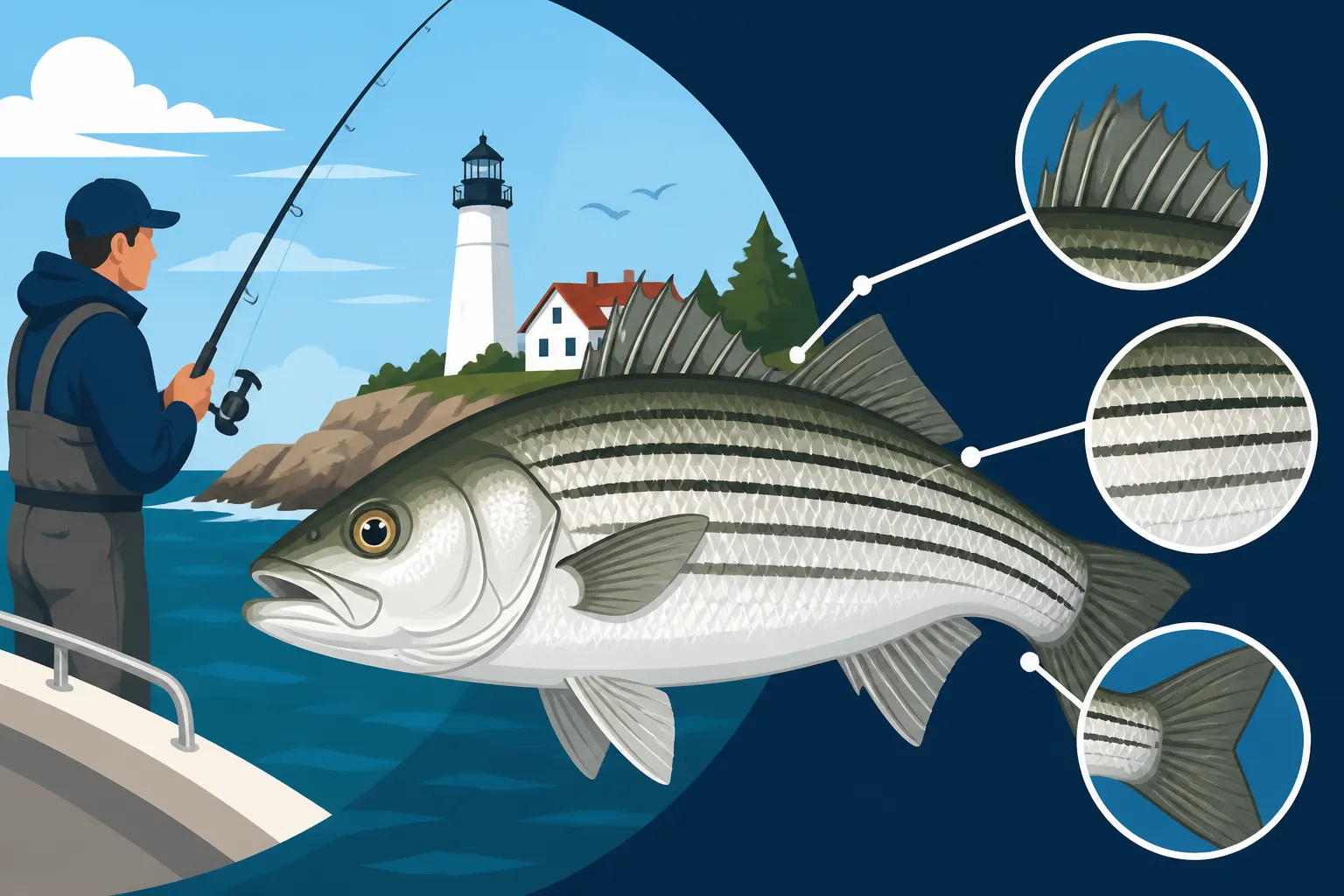
The most defining feature of a striped bass is undoubtedly the series of seven or eight prominent, dark, horizontal stripes that run along its silvery sides. These stripes are typically continuous, meaning they don't break up or become patchy, and they extend from just behind the gill plate all the way to the base of the tail. They sit above the lateral line, a sensory organ visible on many fish, which itself is often a bit darker and more pronounced on a striper.
Imagine you're fishing a tidal river near Brunswick, and you've just hooked into something that's fighting hard. As you bring it closer to the boat or shore, you'll be looking for those strong, unbroken lines. While a white perch, for instance, might have some fainter lines or markings, they won't have the bold, well-defined "ruler lines" that make a striped bass so unmistakable. Even smaller, younger striped bass, often called "schoolies," will exhibit these stripes, though they might appear a bit lighter on their less robust bodies. The consistency and clarity of these stripes are your go-to indicator.
Body Proportions and Profile
Beyond the stripes, the overall body shape of a striped bass is quite telling. They possess a long, sleek, and somewhat compressed body, often described as torpedo-like. This fusiform (spindle) shape is built for speed and power, allowing them to chase down prey in swift currents and open water. Their body is deepest around the middle, tapering gracefully towards both the head and the tail, creating a very hydrodynamic profile.
When you hold a striped bass, you'll notice it feels solid and muscular. Unlike the more rounded, deep-bodied shape of a sunfish or a trout, a striper has a more elongated, athletic build. While a mackerel might also be streamlined, its body is typically much slimmer and more cylindrical, lacking the relative depth of a striper. For a smaller striped bass, sometimes called a "schoolie," their body might appear a bit less robust, but the fundamental proportions remain the same: a lean, powerful, and agile form. This design allows them to navigate diverse environments, from the turbulent surf to the calmer waters of an estuary.
Head and Mouth Features
The head of a striped bass is also quite distinctive, playing a crucial role in its identification. They have a moderately large head with a slightly pointed snout and a noticeably large mouth. A key characteristic is that the lower jaw protrudes beyond the upper jaw, giving them an undershot appearance. This large, upward-angled mouth is perfectly adapted for engulfing prey, whether they're sucking in smaller baitfish or inhaling crabs and other invertebrates from the bottom.
Look closely at the top of the head; you'll often see two distinct dorsal fins. The first dorsal fin is spiny and triangular, while the second is soft-rayed and generally shorter and more rounded. The gill plate, located behind the eye, is smooth and typically does not have sharp spines that might snag your hand. The eyes are moderately sized and set relatively forward on the head. These features, combined with the body shape and stripes, create a unique profile that, once recognized, is hard to forget. Understanding the nuances of their head and mouth can often be the final confirmation when other features are less obvious due to size or environmental factors.
Fin Characteristics and Coloration
While the stripes are often the first thing people notice, the fins and overall coloration of a striped bass provide crucial secondary identification markers. These features, when observed together, complete the picture and help confirm your catch's identity.
Dorsal and Pectoral Fins
A quick glance at the top of a striped bass will reveal its two distinctly separated dorsal fins. This is a very important characteristic to note, as many other fish species have a single, continuous dorsal fin, or two fins that are connected by a membrane. The first dorsal fin is spiny, meaning it's supported by sharp, rigid rays, and it generally stands taller and is more triangular in shape. Behind it, a small gap separates it from the second dorsal fin, which is softer, supported by flexible rays, and typically shorter and more rounded. This separation is a dead giveaway for a striped bass.
Below the body, you'll find the pectoral and pelvic fins. The pectoral fins are relatively large and fan-shaped, positioned just behind the gill covers. They are important for maneuvering and stability. The pelvic fins are smaller and located beneath the pectoral fins, further towards the belly. You've just landed a fish in Casco Bay that put up an incredible fight; as you handle it carefully, you'll notice how these fins are proportioned and placed, contributing to its agile and powerful swimming. These fin structures are a consistent feature across all sizes of striped bass, making them reliable identification points.
Tail Caudal Fin
The tail, or caudal fin, of a striped bass is another key identifier and speaks volumes about its power. It is deeply forked, forming a distinct "V" shape. This deeply incised tail is indicative of a strong swimmer, capable of sudden bursts of speed and sustained pursuit of prey. The lobes of the tail are typically pointed, and the entire structure is robust and muscular.
Compare this to a fish with a more rounded or square tail, and you'll immediately see the difference. The powerful propulsion provided by this deeply forked tail is what allows striped bass to navigate strong tidal currents and make their long coastal migrations. When you feel the strength of a striper on the end of your line, much of that power comes from this highly evolved tail, designed for efficient movement through water. Understanding the tail shape not only helps with identification but also provides insight into the fish's predatory capabilities and lifestyle.
Overall Color Palette
While the stripes are dark, the overall body coloration of a striped bass is generally silvery, shimmering brilliantly in the sunlight. The back is typically darker, ranging from a greenish-blue to a darker olive or almost black, especially in larger, older fish. This darker dorsal coloration provides camouflage from predators looking down from above. The sides transition from this darker shade to a bright, reflective silver, which helps them blend in with the water's surface when viewed from below. The belly is usually a clean, bright white.
The precise shade of the dark back can vary slightly depending on the fish's diet and the clarity of the water it inhabits. For example, a striper caught in murky estuarine waters might have a slightly duller or browner tone to its back compared to one caught in the clearer, open ocean. However, the fundamental pattern of dark back, silvery sides with prominent stripes, and a white belly remains consistent. The vibrant contrast between the dark stripes and the silvery body is truly what makes them stand out and earn their name.
Size, Habitat, and Behavior Clues
Beyond their physical appearance, understanding the typical size, preferred habitats, and characteristic behaviors of striped bass can provide valuable context for identification, especially when you're out on the water.
Typical Size Range and Growth
Striped bass exhibit a wide range of sizes throughout their lifespan, which can sometimes lead to confusion for new anglers. Young striped bass, often called "schoolies" or "micro-stripers," can be as small as 8-12 inches. These smaller fish often travel in large schools, providing fast-paced action for anglers, particularly in the protected waters of estuaries and tidal rivers. As they mature, they grow considerably, with many adult fish commonly reaching lengths in the 20-40 inch range. Some truly massive striped bass, often referred to as "cows," can exceed 50 pounds and measure well over 45 inches.
The size of the fish you encounter often dictates where and how you're fishing. Smaller stripers might be found closer to shore, in shallow flats or around docks, while the larger, more elusive fish might hold in deeper channels or rocky outflows. The growth rate of striped bass is influenced by food availability, water temperature, and genetics, but generally, they are fast-growing fish. Recognizing whether you have a small schoolie or a substantial adult can sometimes be the final confirmation of your catch, especially when considering Striped Bass Size Slot in Maine Explained regulations.
Preferred Habitats in Maine
Striped bass are anadromous, meaning they spend most of their adult lives in saltwater but return to freshwater to spawn. However, here in Maine, you'll primarily find them in our coastal waters, estuaries, and tidal rivers during the warmer months. They absolutely thrive in environments where fresh and saltwater mix, creating rich feeding grounds.
You'll find them congregating in places like Casco Bay, the Kennebec River, the Penobscot River, and along sandy beaches and rocky shorelines all down the coast. They love structure, whether that's submerged rocks, mussel beds, jetties, or even bridge pilings, as these spots provide ambush points for hunting baitfish. Unlike species you might find in Best Fishing Lakes in Maine, stripers are firmly a saltwater and brackish water inhabitant while they're here. Understanding their preferred hangouts helps you narrow down potential species before you even cast a line. If you're fishing in a freshwater lake far from the coast, you're highly unlikely to encounter a true striped bass. They are a quintessential symbol of Maine's vibrant coastal fishery.
Distinctive Behaviors and Feeding Habits
Striped bass are renowned for their aggressive feeding behavior, which is often a spectacle to behold. They are opportunistic predators, feasting on a wide variety of baitfish like herring, mackerel, and sand eels, as well as crabs, shrimp, and even squid. One of the most thrilling behaviors is when a school of stripers "blitzes" a bait ball, driving the smaller fish to the surface in a frenzy of splashing and jumping. Seeing gulls diving and fish erupting from the water is a sure sign that stripers are on the hunt.
Imagine watching a school of stripers erupt on a bait ball near Popham Beach; the sheer power and coordinated attack are unmistakable. They are also known to be strong migratory fish, moving along the Atlantic coast with the seasons, arriving in Maine as the water warms and departing for southern waters as temperatures drop. This migratory pattern, combined with their schooling behavior and powerful strikes on your line, creates a unique fishing experience. When you feel that powerful tug and see the water explode as you hook into one, it's often the behavior itself that confirms you've encountered a striped bass. Many anglers target them using methods like How to Fish for Striped Bass From Shore, which takes advantage of their predictable feeding patterns near the coastline.
Distinguishing Striped Bass from Similar Species
Even with all the identifying characteristics, it's easy to get confused when you're looking at a fish that shares some superficial similarities. Here in Maine, there are a few species that anglers might occasionally mistake for striped bass, especially when the fish are smaller. Knowing the subtle differences can prevent misidentification and ensure you comply with all local regulations.
Striped Bass vs. White Perch
This is perhaps the most common identification challenge for striped bass anglers, especially with smaller fish. Both species have a generally silvery appearance and can display some horizontal lines. However, there are several key differences:
- Body Shape: White perch have a much deeper, more compressed, and disk-like body compared to the elongated, torpedo-shaped striped bass. They look "taller" for their length.
- Stripes: While white perch can have faint lateral lines, they are rarely as prominent, continuous, or numerous as the bold, dark stripes on a striped bass. Often, the lines on a white perch are barely visible or broken.
- Mouth: A striped bass has a noticeably larger mouth with a protruding lower jaw. The white perch's mouth is smaller and more terminal (meaning the upper and lower jaws meet evenly at the front).
- Size: White perch are generally much smaller, typically topping out at less than 12-15 inches, whereas even small "schoolie" stripers can quickly exceed that length.
- Dorsal Fins: Striped bass have two separate dorsal fins. White perch have two dorsal fins that are connected at the base, even if only by a thin membrane, making them appear as one continuous fin.
Here's a quick comparison:
| Feature | Striped Bass | White Perch |
|---|---|---|
| Body Shape | Long, sleek, torpedo-like | Deeper, more compressed, disk-like |
| Stripes | 7-8 prominent, dark, continuous lines | Fainter, fewer, often broken or absent lines |
| Mouth | Large, lower jaw protrudes | Smaller, jaws meet evenly |
| Dorsal Fins | Two distinctly separate fins | Two fins connected at base (appear continuous) |
| Typical Size | Small schoolies to large adults (up to 50lb+) | Generally smaller (up to 15 inches) |
Striped Bass vs. Atlantic Salmon Juvenile
In some of Maine's tidal rivers where both species might be present, particularly where Maine Atlantic Salmon Restoration Efforts are underway, there's a slim chance a juvenile Atlantic salmon could be mistaken for a small striper. However, these are quite different fish:
- Parr Marks: Juvenile Atlantic salmon (and other trout species) will have distinct "parr marks" – dark, oval blotches along their sides, often accompanied by red spots. Striped bass never have parr marks.
- Adipose Fin: Atlantic salmon have a small, fleshy adipose fin between their dorsal and tail fins. Striped bass do not have an adipose fin.
- Stripes: While salmon might have some faint horizontal markings, they won't have the distinct, continuous dark stripes of a striped bass.
- Mouth: Salmon have a mouth that is typically smaller and ends around the middle of the eye.
- Dorsal Fins: While both have two dorsal fins, the overall fin structure and body shape are quite different. For a deeper dive into salmon identification, you can read Landlocked Salmon vs Atlantic Salmon Differences.
Striped Bass vs. Smallmouth or Largemouth Bass
While these are primarily freshwater species, anglers might briefly wonder if they've caught a type of "bass." It's important to note that smallmouth and largemouth bass are not typically found in the same saltwater or brackish environments where striped bass thrive, though there can be some overlap in certain estuarine areas with largemouth. The differences are significant:
- Stripes: Neither smallmouth nor largemouth bass have the distinct, continuous horizontal stripes of a striped bass. Smallmouth bass typically have vertical bars or blotches, while largemouth bass have a jagged, irregular horizontal band.
- Dorsal Fins: Smallmouth and largemouth bass have a single, deeply notched dorsal fin that appears almost as two, but they are clearly connected. Striped bass have two distinctly separate dorsal fins.
- Body Shape: While also powerful fish, smallmouth and largemouth bass generally have a deeper, more robust, and less streamlined body than a striped bass.
- Mouth Size: Largemouth bass, as their name suggests, have a massive mouth where the jaw extends well beyond the eye. Smallmouth bass have a mouth that extends to about the middle of the eye. A striped bass's mouth is large but typically doesn't extend as far back as a largemouth's.
- Habitat: Smallmouth and largemouth bass are almost exclusively freshwater fish, inhabiting lakes, ponds, and rivers. Striped bass are coastal, estuarine, and tidal river inhabitants. For more on distinguishing these freshwater cousins, check out How to Identify Smallmouth vs Largemouth Bass.
Practical Identification Tips for Anglers
Having a solid understanding of a fish's physical traits is one thing, but applying that knowledge on the water, especially when you're excited or trying to be quick with a release, requires a few practical strategies.
When in Doubt, Release
This is perhaps the most crucial tip, not just for striped bass, but for all species, especially in a state like Maine with its strong conservation ethics. If you've caught a fish and you're genuinely unsure if it's a striped bass, or if it meets the specific size regulations, the safest and most responsible course of action is to release it immediately and unharmed. The momentary disappointment of releasing a legal fish is far better than facing a penalty for keeping an illegal one or, more importantly, harming a valuable fish stock.
Consider carrying a small, waterproof camera or your phone in a waterproof case. If you're really stumped, take a quick photo of the fish while it's still in the water or held gently, noting its prominent features, and then release it. You can review the photo later or even consult with experienced anglers. This practice aligns perfectly with Catch and Release Best Practices in Maine, ensuring the health and sustainability of our fisheries. Your quick action can make a big difference for the fish's survival.
Tools and Resources for Identification
Don't rely solely on memory! There are excellent tools available to assist with on-the-spot identification.
- Field Guides: A good waterproof fish identification field guide specific to marine species in the Northeast is an invaluable asset. You can find excellent waterproof field guides, or even dedicated fish identification apps for your smartphone, available through retailers like Amazon, that specifically highlight the unique characteristics of species like striped bass. These guides often feature clear illustrations or photos with key features highlighted, making comparisons much easier.
- Fishing Apps & Websites: Many modern fishing apps offer fish identification features, allowing you to upload a photo and get suggestions, or simply browse detailed profiles of local species. The Maine Department of Inland Fisheries and Wildlife (MDIFW) website and related resources are also fantastic for information on local fish and Maine Fishing Regulations Explained.
- Laminated ID Cards: For quick reference right on the water, some anglers even print out or purchase laminated identification cards (check Amazon for these convenient accessories) that show side-by-side comparisons of common species, emphasizing the differentiating features. These can be clipped to your tackle box or vest for easy access.
- Measuring Tools: Always carry a reliable measuring device. Whether it's a tape measure, a specialized fish ruler, or markings on your boat, knowing the exact length of your catch is paramount, especially with Striped Bass Slot Limit in Maine Explained regulations in mind. Equipping yourself with tools like a good measuring tape and a scale, often found on Amazon, can also help reinforce identification by comparing your catch to typical size ranges.
Understanding Regulations Based on Identification
Accurate identification isn't just about curiosity; it's a critical component of responsible angling and compliance with fishing laws. Different species have different bag limits, size restrictions, and open seasons. For striped bass, Maine often employs a "slot limit," meaning you can only keep fish within a specific length range, with fish outside that range needing to be released. This makes precise identification and measurement absolutely essential.
Imagine the scenario: you've just landed a beautiful fish, and you're fairly certain it's a striper. Now, you need to quickly and accurately measure it to see if it falls within the legal slot. Mistakes can happen, and they can be costly. Not knowing the difference between a striped bass and a white perch could lead to accidentally keeping a protected species or exceeding a bag limit. Always be familiar with the most current Maine Fishing Regulations Explained before you head out, and remember that you'll need a valid Maine Fishing License Guide and often a Maine Saltwater Fishing Registry Guide to fish for them legally. Being informed and prepared helps ensure that you contribute to the sustainability of Maine's incredible fishing resources for years to come.
Disclaimer
This article is for general informational purposes only and does not constitute professional advice. Laws, prices and regulations vary by location and change over time. Consult a qualified professional for guidance on your specific situation.