How to Anchor a Kayak for Fishing
There’s nothing quite as frustrating as finally paddling into that perfect pocket of water, the one you just know holds a trophy fish, only for the slightest breeze or current to nudge your kayak off course. You spend more time paddling back into position than actually fishing, and that's not what anyone signed up for when they hit the water! This guide is here to walk you through everything you need to know about effectively anchoring your kayak for fishing, so you can stay put, focus on your cast, and land that big one in Maine's beautiful waters.
Why Anchoring Your Kayak is a Game Changer for Fishing
When you're out on the water in your fishing kayak, especially in Maine's diverse environments from tidal rivers to expansive lakes, staying in one spot can feel like an impossible dream. You're trying to cast, manage your line, perhaps even net a fish, all while battling the elements. It’s a challenge that many new (and even experienced) kayak anglers face, and it can seriously impact your enjoyment and success on the water.
The Frustration of the Drift
Picture this: you've been working a rocky shoreline on a lake like Sebago Lake, targeting smallmouth bass. You spot a submerged log, a prime ambush point. You make a perfect cast, the lure lands exactly where you want it, and bam! A fish strikes. But just as you're fighting it, a gust of wind catches your kayak, pulling you away from the structure. You either have to break off the fight to paddle, or risk losing the fish and missing the hot spot. It's enough to make you want to throw your paddle in the water! The drift isn't just annoying; it can actively prevent you from effectively working a piece of structure, or holding over a school of fish you've found on your fish finder. When you're trying to carefully present a fly or jig in a particular depth or current seam, constant repositioning is a huge time-waster and a major distraction.
Gaining Control: Why Stability Matters
Anchoring provides that crucial stability that transforms your kayak from a free-floating vessel into a stable fishing platform. Imagine being able to hold your position precisely over a drop-off where landlocked salmon are lurking, or steady yourself in a swift section of the Kennebec River while fly-fishing for trout. This control allows you to concentrate on your technique, whether you're trying Casting Techniques for Beginners or mastering Jigging Techniques for Togue. It means more time with your lure in the strike zone and less time wrestling with your boat. Beyond just making fishing easier, it also greatly enhances safety, especially if you're fishing alone in Maine and want to avoid being blown into hazards or out into open, rougher water. You can truly immerse yourself in the experience, feeling more connected to the water and the fish, rather than constantly feeling like you're fighting your own boat.
Different Types of Kayak Anchors: Choosing Your Weapon
Just like choosing the right lure, picking the right anchor for your kayak depends on where you're fishing and what kind of bottom you're dealing with. There isn't a one-size-fits-all solution, and understanding the strengths and weaknesses of each type will make your life much easier on the water.
Grapple Anchors: The Versatile Gripper
Grapple anchors, often called folding grapnel anchors, are incredibly popular among kayak anglers, and for good reason. They feature four "flukes" that can be folded in for compact storage or fanned out to grab onto various bottom types.
- How They Work: When deployed, the flukes dig into mud, sand, weeds, or snag onto rocks and submerged structures. The design allows them to get a good hold without being overly heavy, which is a big plus when you're paddling a kayak.
- Best for Maine Waters: These are fantastic for most freshwater lakes and ponds in Maine, where you might encounter a mix of muddy, sandy, or rocky bottoms. If you're targeting smallmouth bass in the Belgrade Lakes, or searching for brook trout in a remote pond, a grapple anchor will serve you well. They’re also decent in slower-moving rivers.
- Considerations: While versatile, they can get snagged permanently on very rocky or heavily structured bottoms. It’s a good idea to rig them with a "breakaway" system using a zip tie at the bottom of the anchor, so if it gets truly stuck, a hard tug can break the zip tie and allow you to retrieve it from the top. You can find many reliable and affordable grapple anchors on Amazon, often complete with rope and a float.
Mushroom Anchors: The Soft Bottom Specialist
Mushroom anchors are simple, effective, and often overlooked for kayak fishing, but they have a specific niche where they excel.
- How They Work: Shaped like an inverted mushroom or bell, these anchors are designed to sink into soft, muddy, or silty bottoms and create suction, providing excellent holding power. They generally require more weight than a grapple anchor to be effective in moving water or wind.
- Best for Maine Waters: If you frequently fish shallow, muddy coves or slow-moving, soft-bottom rivers like the lower Saco River, a mushroom anchor can be surprisingly effective. They're also less likely to snag than grapple anchors, making them a good choice if you're fishing areas with lots of submerged debris but still a soft bottom.
- Considerations: Their main drawback is their lack of holding power on hard, sandy, or rocky bottoms. They also take up more space and can be heavier for their holding power compared to a grapple. However, for specific soft-bottom scenarios, they're unbeatable.
Drag Chains & Stakeout Poles: Niche, but Handy
Sometimes, a traditional anchor isn't quite the right tool. This is where drag chains and stakeout poles come in.
- Drag Chains: A simple length of heavy chain, often 5-10 feet long, used without a traditional anchor head. It's not designed to "anchor" in the true sense, but rather to slow your drift significantly.
- Best for Maine Waters: Excellent for managing your drift in moderately flowing rivers where you want to cover ground slowly, or when drifting flats for striped bass along the Maine coast. It allows you to present your lure through a longer stretch of water while maintaining control.
- Considerations: Doesn't stop you completely, and only works well on relatively flat, soft bottoms.
- Stakeout Poles: A sturdy pole (fiberglass, carbon fiber, or aluminum) that you manually push into the soft bottom to hold your kayak in place.
- Best for Maine Waters: Ideal for very shallow water fishing, such as tidal flats, marsh edges, or shallow lake coves. If you're stalking white perch in a shallow lake, this is an incredibly quiet and effective option.
- Considerations: Only works in shallow water where the pole can reach the bottom and penetrate it sufficiently. Not suitable for deep water or hard bottoms. They are silent and provide instant, secure hold when applicable.
Here's a quick comparison of common kayak anchor types for Maine fishing:
| Anchor Type | Ideal Bottom Type | Best Use Cases in Maine | Pros | Cons |
|---|---|---|---|---|
| Grapple Anchor | Mixed, Sandy, Rocky, Weedy | Lakes (Moosehead, Sebago), Rivers (Kennebec, Penobscot) | Versatile, compact, good holding power | Can snag, might require breakaway system |
| Mushroom Anchor | Soft Mud, Silt, Weedy | Shallow coves, slow rivers (Saco), marshy areas | Excellent in soft bottoms, less snagging | Poor on hard/rocky bottoms, heavier for holding |
| Drag Chain | Flat, Soft, Moderately Flowing | Drifting rivers or coastal flats for stripers | Slows drift effectively, simple | No full stop, limited to specific conditions |
| Stakeout Pole | Very Shallow, Soft Mud/Sand | Tidal flats, shallow lake edges, quiet coves | Silent, instant hold, no rope needed | Only for shallow water, specific bottom type |
Rigging Your Kayak for Effective Anchoring
Having the right anchor is only half the battle. How you deploy and retrieve it is just as important. For kayak fishing, a proper rigging setup, particularly an anchor trolley system, is absolutely essential. It makes your anchoring safer, more efficient, and much more versatile.
The Essential Anchor Trolley System
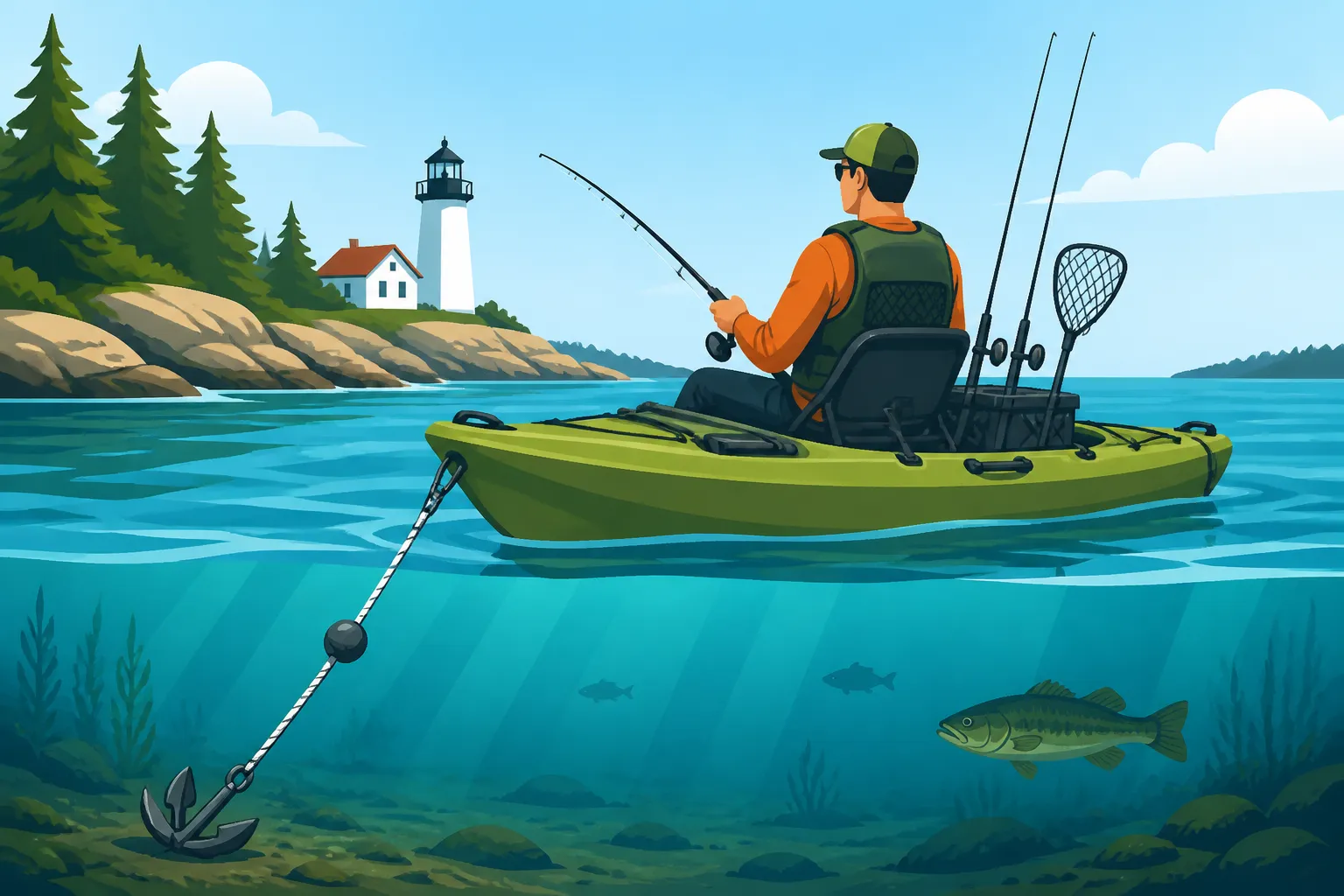
An anchor trolley is a simple yet revolutionary system for kayak anglers. It's essentially a loop of rope or cable that runs along one side of your kayak, from bow to stern, through a couple of pulleys. Your anchor line attaches to this loop via a ring or carabiner.
- How it Works: Instead of having to deploy your anchor directly from a fixed point on your bow or stern (which can be dangerous or put you in an awkward position), the anchor trolley allows you to move your anchor attachment point along the length of your kayak.
- Safety First: Imagine you're anchored from the stern, and a strong wind or current picks up. Your kayak could be swamped or flipped by waves crashing over the stern. With an anchor trolley, you can quickly slide the anchor attachment point to the bow, reorienting your kayak to face into the waves or current, dramatically increasing stability and safety. This is especially crucial when fishing on large, exposed bodies of water like Moosehead Lake Fishing Guide or when the wind picks up suddenly.
- Positional Advantage: Beyond safety, the trolley lets you fine-tune your position. Want to cast downwind? Move the anchor point to your bow. Want to swing your stern closer to a structure? Slide the anchor point towards the back. It gives you incredible control over your boat's orientation relative to your anchor. You can find comprehensive anchor trolley kits on Amazon, often including everything you need for installation.
Components of an Anchor Rig
To set up your anchor effectively, you'll need a few key components in addition to your chosen anchor and the anchor trolley.
- Anchor Line (Rope): This isn't just any rope. You need a strong, durable, and relatively thin line that is resistant to abrasion and UV degradation. Braided nylon or polypropylene are common choices. The length should be appropriate for the depths you'll be fishing – generally, 3-5 times the maximum depth, plus some extra for current or wind. For typical Maine lake fishing, 50-75 feet is a good starting point. You'll want to avoid anything that floats too much if you're fishing in current, as it can create too much drag.
- Quick Release System: This is a non-negotiable safety feature. In an emergency (e.g., getting snagged in a strong current, or encountering unexpected hazards), you need to be able to instantly free yourself from your anchor. This can be as simple as a cleat where you can quickly untie, or a purpose-built quick-release mechanism. Practice using it! Knowing how to release your anchor in a hurry could save your life, especially if you get caught up in strong currents on a river like the Penobscot.
- Float/Marker Buoy: Attaching a small float or marker buoy to the end of your anchor line allows you to quickly detach from your anchor and then easily retrieve it later. If you hook into a monster fish that pulls you away, or if you need to quickly release your anchor to pursue a fish or avoid danger, you can simply unclip your anchor line from your kayak and let the float mark its position for later retrieval.
Anchoring Techniques: The Art of Staying Put
Once your kayak is rigged, it’s time to learn the practical skills of deploying and retrieving your anchor. There's a bit of an art to it, and practicing in different conditions will make you a much more confident and effective angler.
Deployment: Gently Does It
Dropping your anchor might seem straightforward, but there are a few techniques that will make it smoother and more effective, reducing the risk of spooking fish or getting tangled.
- Approach the Spot: Paddle slightly upwind or upstream from your desired fishing spot. This gives you a little room to drift back into position as the anchor sets. If you're fishing a specific structure you found using Reading Lake Structure for Bass and Trout, approach it from an angle that lets you present your lure effectively.
- Ease it Down, Not Drop it: Don't just heave your anchor overboard. Lower it gently, hand-over-hand, until you feel it touch the bottom. This prevents a loud splash that can scare fish and reduces the chance of the anchor line tangling.
- Pay Out Line: Once the anchor is on the bottom, continue to pay out anchor line. The "scope" (the ratio of rope length to water depth) is crucial for a good set. A general rule of thumb is a 3:1 or 5:1 scope – meaning if you're in 10 feet of water, you'd want 30-50 feet of line out. This allows the anchor to lie flat and dig in, rather than pulling straight up. In stronger currents or windy conditions, you might need even more scope.
- Engage the Trolley: Once your anchor is set and holding, use your anchor trolley to adjust your kayak's position. Slide the attachment point forward or backward until you're oriented perfectly for casting. This also helps distribute the pull of the anchor, making your kayak more stable.
Retrieval: The Un-Stuck Strategy
Retrieving an anchor, especially one that's well-set or slightly snagged, requires a bit of finesse.
- Paddle Towards the Anchor: The easiest way to retrieve an anchor is to reduce the scope. Paddle directly over where your anchor is set, pulling in line as you go. This changes the angle of pull on the anchor, making it much easier to free.
- Pull Straight Up: Once you're directly above the anchor, pull straight up with steady pressure. If it’s a grapple anchor, the flukes should dislodge. If it feels stuck, try pulling from a slightly different angle, or give a sharp, firm tug.
- The "Breakaway" Method (for Snags): If you've rigged your grapple anchor with a breakaway system, and it's truly stuck, paddle a short distance in the opposite direction of your anchor line, then give a hard, sustained pull. This should snap the zip tie, allowing you to pull the anchor free from the top. Then, you'll just need to re-rig your breakaway for next time.
- Clean and Store: Once retrieved, shake off any mud or weeds, and store your anchor securely. Many kayak anglers keep their anchor in a dedicated bag or bucket to prevent mud or water from getting all over the kayak.
Advanced Tips for Maine's Diverse Waters
Fishing in Maine means encountering a wide range of conditions, from calm lake mornings to windy coastal afternoons. Adjusting your anchoring strategy is key.
- Windy Days on Lakes: When fishing big lakes like Sebago, where the wind can really kick up, always anchor from the bow (front) using your anchor trolley. Facing into the wind keeps your kayak stable and prevents waves from swamping you. Remember, How Wind Affects Lake Fishing can dramatically impact your experience, so plan accordingly.
- River Current Management: In rivers, you generally want to anchor from the bow, facing upstream. This keeps you stable against the current. If you need to swing your stern around to fish a downstream eddy, use your anchor trolley to shift the attachment point. Always be mindful of the current and ensure your quick-release is easily accessible.
- Tidal Waters: When fishing for striped bass in a tidal river or estuary, consider the changing tides. You might need to adjust your anchor position or scope as the water level rises or falls, or as the current shifts direction. Sometimes, anchoring is less about stopping completely and more about using a drag chain to control a slow drift across a flat, which can be a highly effective technique for covering water.
- Anchoring for Kayak Fishing: For more specific advice on using your kayak for fishing, check out our guide on Kayak Fishing Techniques for Maine Lakes. It covers everything from paddle strokes to fish finding, all with an eye toward improving your angling adventures.
Remember, practice makes perfect. Spend some time in calmer conditions getting familiar with your anchor system before tackling more challenging environments. It's an investment in your safety and your fishing success, ensuring you spend more time casting and less time drifting!
Disclaimer
This article is for general informational purposes only and does not constitute professional advice. Laws, prices and regulations vary by location and change over time. Consult a qualified professional for guidance on your specific situation.