How to Identify Smallmouth vs Largemouth Bass
It’s a common scenario for any angler in Maine: you feel that tell-tale tug on your line, reel in your catch with anticipation, and as the fish breaks the surface, you find yourself asking, "Is that a smallmouth or a largemouth bass?" Both species are incredibly popular throughout our beautiful state, offering thrilling fights and rewarding days on the water, but they have distinct characteristics that, once you know them, make identification a breeze. This guide will help you confidently tell the difference between these two freshwater titans, from their physical traits to their preferred haunts and fighting styles.
The Tale of Two Bass: What Are We Looking At?
Before we dive into the nitty-gritty of identification, let's get acquainted with these two fantastic fish. While both are members of the Micropterus genus, often called "black bass," they have evolved to thrive in different environments and possess unique attributes that make each a special catch. Understanding their general profiles is the first step in appreciating their differences.
Meet the Largemouth Bass (Micropterus salmoides)
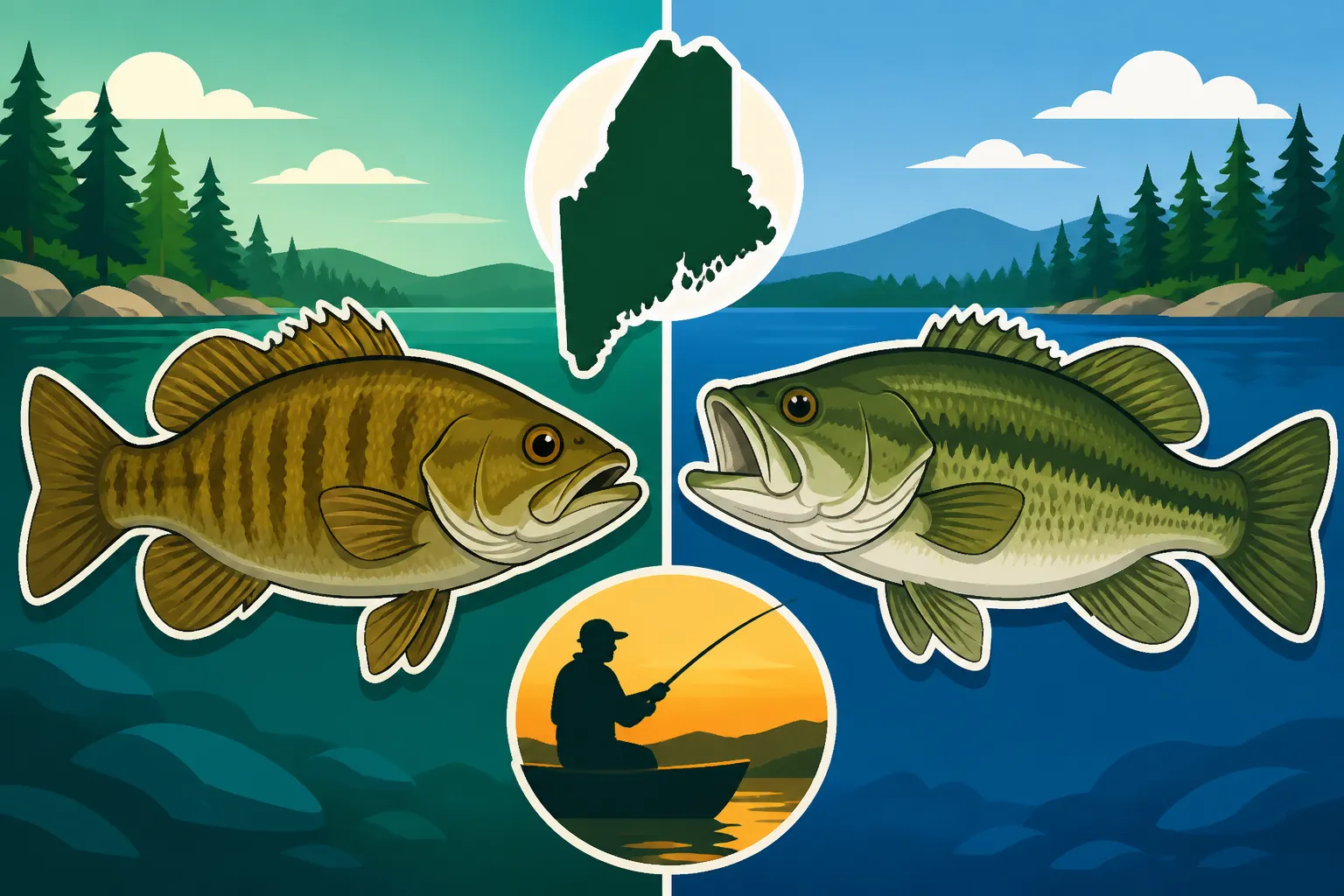
The largemouth bass is arguably the most famous freshwater game fish in North America, and it certainly holds a special place in the hearts of many Maine anglers. Known for its aggressive strikes and powerful, acrobatic fights, the largemouth is a true powerhouse. They tend to have a stockier, deeper body compared to their smallmouth cousins, often giving them a "football" shape. When you hold a largemouth, you'll immediately notice its heft. They are typically olive green to dark green on their back, fading to a lighter green or white on their belly, and almost always feature a prominent, dark, horizontal stripe or series of blotches running along their sides, although this can be less pronounced in very clear water. They thrive in warmer water and are often associated with heavy cover, making them a favorite target for those who love to cast into lily pads and dense vegetation. For more on where these fish like to hang out, check out our guide on Largemouth Bass Habitat in Maine Lakes.
Get to Know the Smallmouth Bass (Micropterus dolomieu)
The smallmouth bass, on the other hand, is a feisty, hard-fighting fish renowned for its aerial acrobatics and relentless tug-of-war on the line. Often called "bronze-backs" or "brown bass," smallmouths typically have a more streamlined, torpedo-shaped body, built for speed and navigating rocky structures. Their coloration ranges from a coppery brown to bronze or olive-green on their back, with lighter flanks and a white belly. Instead of a solid lateral line, smallmouths usually display vertical bars or blotches along their sides, which can vary in intensity depending on the water clarity and substrate. These fish prefer cooler, clearer waters with rocky bottoms and gravel, often found in rivers and deeper sections of lakes. Many anglers consider the smallmouth to be the pound-for-pound strongest fighter of the two, putting up a spirited battle with vigorous head shakes and leaps out of the water. If you're looking for specific places to target these energetic fish, our article on Sebago Lake Smallmouth Bass Fishing in Maine is a great resource.
Unmistakable Visual Cues: Telling Them Apart by Appearance
While their general appearances might seem similar at first glance, a closer look reveals several key physical differences that make distinguishing a largemouth from a smallmouth bass surprisingly straightforward. These markers are consistent and reliable, no matter where in Maine you hook into one.
The Mouth: The Most Obvious Identifier
This is hands down the easiest and most reliable way to tell these two bass apart. It's right there in their names! The key is to look at how far back their jaw extends in relation to their eye.
For the largemouth bass, if you imagine a vertical line running down from the back edge of its eye, the corner of its mouth will extend beyond that line. It’s a truly capacious maw, perfectly adapted for engulfing large prey like frogs, baitfish, and even small ducklings. When you open their mouth, it really does look disproportionately large compared to their head size. This exaggerated jawline is a defining feature and almost always the first thing seasoned anglers check. You can even gently hold the fish's jaw and easily see how far back it goes.
Conversely, for the smallmouth bass, the corner of its mouth will not extend beyond that imaginary vertical line from the back of its eye. Its mouth is noticeably smaller and more proportionate to its head. While still a formidable predator, the smallmouth's feeding strategy is often more about precision and quick strikes on smaller prey like crayfish and minnows, rather than the wide-mouthed gulp of its cousin. This difference is so clear that once you’ve seen it a few times, you’ll be able to identify them instantly even from a distance.
Dorsal Fin Separation: A Clear Dividing Line
Another incredibly reliable and often overlooked visual cue lies in their dorsal fins – those spiny fins on their back. This characteristic is a definitive anatomical difference between the two species.
The largemouth bass has two dorsal fins, but they are almost always clearly separated or at least deeply notched. Imagine two distinct triangular fins, one spiny and one soft-rayed, connected by only a very low membrane, or sometimes appearing as two entirely separate fins. When you run your finger lightly along the top of their back, you'll feel a distinct dip or gap between the spiny front section and the softer rear section. This clear separation is a consistent trait for largemouths.
For the smallmouth bass, the two dorsal fins are connected, forming one continuous fin. While there will still be a spiny front section and a soft-rayed rear section, there is no deep notch or separation. It presents as a single, elongated dorsal fin that smoothly transitions from the spiny rays to the softer ones. Feeling along the back of a smallmouth, you'll notice a continuous ridge without the prominent dip or gap found on a largemouth. This single, connected dorsal fin is a solid diagnostic feature that can confirm your identification, especially if you're still a bit unsure about the mouth size.
Coloration and Pattern: More Than Just Green
While both bass species exhibit a range of colors influenced by their environment, there are general patterns and hues that can help differentiate them. It's important to remember that a fish's color can be brighter or duller based on water clarity, light conditions, and even stress levels.
The largemouth bass typically boasts a body color that ranges from bright emerald green to a darker, almost blackish-green on its back, fading to a lighter green or sometimes yellow-green on its sides, and a white belly. The most striking feature, however, is the prominent, dark, horizontal lateral line or stripe that runs from its gill plate all the way to its tail. This stripe often appears as a series of connected blotches or a solid band. In some stained or very clear waters, this lateral line might appear less distinct or even mottled, but it's usually present. Think "camouflage in weeds and shadows."
The smallmouth bass, by contrast, often has a much more "bronzier" or coppery appearance, sometimes with an olive-green sheen, particularly on its back and upper sides. Instead of a horizontal stripe, smallmouths are characterized by several dark, vertical bars or splotches along their sides. These bars can be very prominent, especially in clear, rocky waters, giving them a striped or banded look. Their eyes also often have a reddish or orange tint, a subtle but distinguishing feature. The overall impression is one of a sleek, rock-dwelling predator, perfectly blending with gravel and stone.
Body Shape and Structure: Build for Different Battles
Beyond the mouth, fins, and colors, the overall body shape and finer structural details also provide clues about which bass you've landed. Their builds reflect their preferred habitats and hunting styles.
The largemouth bass tends to have a more robust, "pot-bellied" or football-like body. It's deeper from back to belly and often appears stockier and chunkier. This build is well-suited for short, explosive bursts from cover to ambush prey. Their bodies feel more compressed and disc-shaped than the smallmouth. The scales on a largemouth are generally larger than those on a smallmouth. Their overall head profile also seems larger in proportion to their body than a smallmouth's, further emphasizing that big mouth.
The smallmouth bass has a more elongated, slender, and athletic body shape. Think of it as a torpedo built for speed and agility in open water or strong currents. Their body is less deep and more rounded, allowing them to knife through the water with ease. They are muscled from head to tail, reflecting their hard-fighting nature. Their scales are typically smaller and finer than those of a largemouth, giving them a smoother appearance. When you look at a smallmouth, it looks "streamlined" and powerful, ready for a drag-peeling run or a series of breathtaking jumps.
Here’s a quick summary table to help keep these visual cues straight:
| Feature | Largemouth Bass | Smallmouth Bass |
|---|---|---|
| Mouth Position | Jaw extends beyond the back of the eye | Jaw does not extend beyond the back of the eye |
| Dorsal Fin | Deeply notched or clearly separated into two fins | Connected, forming one continuous fin |
| Coloration | Olive green, dark horizontal lateral stripe/blotches | Coppery brown/bronze, vertical bars/blotches |
| Body Shape | Stockier, deeper, more "football-shaped" | More slender, streamlined, "torpedo-shaped" |
| Eye Color | Typically dark | Often has a reddish or orange tint |
| Scales | Generally larger | Generally smaller and finer |
Habitat Preferences in Maine: Where Do They Live?
Knowing where each species prefers to live can give you a strong hint about what you’ve caught, even before you see it. In Maine, both smallmouth and largemouth bass are widely distributed, but they definitely have their favorite haunts. Their habitat choices are dictated by factors like water temperature, depth, clarity, and available structure.
Largemouth's Love for Lunkers (and Weeds)
The largemouth bass is undeniably a warm-water fish. They thrive in environments where the water heats up, making them a common sight in many of Maine's shallow lakes, ponds, and slower-moving river sections. Think about those serene, often somewhat murkier waters that might have a soft bottom.
Their ideal home is typically characterized by an abundance of aquatic vegetation – lily pads, submerged grass beds, cattails, and rushes. These areas provide not only excellent cover for ambushing prey but also shade from the summer sun, which they definitely appreciate. You'll often find largemouths tucked right up against structures like fallen trees, brush piles, docks, and even old tires. They are ambush predators through and through, preferring to hide in these dark, shadowy places, waiting for an unsuspecting meal to swim by. If you’re fishing a pond that’s rich in weeds and has plenty of shallow coves, chances are you’re in largemouth territory. They are often found in the shallower, warmer coves and bays of larger lakes, particularly in central and southern Maine. They often don't venture into the main, deeper basins unless there's a specific structure or food source. For tips on where to find these fish and strategies for catching them, you might want to explore our Maine Bass Fishing Limits by Zone guide, as regulations can differ.
Smallmouth's Rocky Domain (Clearer, Cooler Waters)
In stark contrast, the smallmouth bass is a creature of cooler, clearer, and often deeper waters. They are perfectly adapted to environments with rocky bottoms, gravel shoals, and sharp drop-offs. While they are present in many Maine lakes, you’ll find them particularly abundant in our larger, oligotrophic (nutrient-poor, clear water) lakes and the faster-flowing sections of rivers.
Smallmouths prefer structure too, but their definition of structure is more about rocks, boulders, ledges, and gravel humps rather than dense vegetation. They love to patrol rocky points, offshore humps, and the edges of sharp breaks where they can find crayfish and baitfish. These fish are more active hunters, often chasing down prey in open water or along rocky contours. If you’re on a lake known for its crystal-clear water, deep sections, and rocky shorelines, you're likely fishing prime smallmouth habitat. Rivers with good current and plenty of rock gardens are also smallmouth heaven. Kennebec River Fishing Access Points in Maine might offer some great insights into finding smallmouth in riverine environments. Their preference for colder water means they'll often go deeper in the heat of summer, retreating to thermoclines, while largemouths might remain shallower in the cover.
Behavioral Differences: How They Act and Fight
Beyond their looks and living arrangements, smallmouth and largemouth bass display distinct behavioral patterns, especially when hooked. These differences contribute to their reputations among anglers and can even help you identify your catch based on how it fights.
The Largemouth's Ambush and Power
When a largemouth bass strikes, it's often an explosive, startling event, particularly if you're fishing topwater lures over heavy cover. They are ambush predators, meaning they'll lie in wait, hidden amongst the weeds or structure, and then burst out to engulf their prey. Their strike is usually a powerful, jarring hit, and they tend to try and use the surrounding cover to their advantage.
Once hooked, a largemouth's fight is characterized by raw power and a stubborn refusal to leave its home turf. They will often dive deep into weeds or around submerged timber, attempting to break your line or spit the hook. You'll feel strong head shakes and sometimes they'll "bulldog" you, staying deep and pulling hard. They also have a knack for jumping out of the water, often with a violent head shake, trying to throw the lure. This impressive leap, combined with their bulk, makes for a thrilling fight, but their primary goal is usually to get back into heavy cover. They're like a heavyweight boxer, relying on brute force and their environment to gain the upper hand.
The Smallmouth's Leaps and Hard Runs
The smallmouth bass, true to its streamlined form, is known for a more athletic and acrobatic fight. Their strikes can be aggressive and sudden, especially in moving water or when chasing down a baitfish imitation. They are often more active hunters, chasing down prey in open water or along rocky structures.
Once hooked, a smallmouth is a force to be reckoned with. They are famous for their spectacular aerial displays, jumping clear out of the water multiple times in a single fight. These aren't just half-hearted splashes; they are full-body leaps and head shakes that can really test your drag and knot strength. Besides jumping, smallmouths are also known for their long, hard runs, often tearing off line as they try to escape into deeper water or around rocky ledges. They pull with immense power for their size, giving a relentless fight that many anglers compare to catching a miniature salmon. Their fight feels more dynamic and energetic, a true testament to their "bronze-back" nickname and their preference for open, clear water. If you're looking for a challenging fight that keeps you on your toes, smallmouths rarely disappoint.
Fishing Strategies and Identification: Catching Clues
Even your approach to fishing can give you hints about which bass species you're likely to encounter, and therefore, which you might be trying to identify. Different lures and techniques are often employed specifically to target one species over the other, aligning with their unique habitats and feeding behaviors.
Lure Choices and Presentation as a Clue
The types of lures you choose and how you present them are often tailored to the specific bass species you're after. This means if you're fishing with a certain setup, you can often make an educated guess about your catch.
For largemouth bass, lures designed to be fished in or around heavy cover are typically preferred. Think soft plastics like Texas-rigged worms, Senkos, creature baits, or jigs that can be pitched into thick vegetation without snagging. Topwater frogs, poppers, and buzzbaits are also deadly in shallow, weedy areas where largemouths ambush their prey. Spinnerbaits and chatterbaits are great for working through sparse cover. If you’re casting a big plastic worm into a lily pad field, and you get a strike, there’s a very high probability you’ve hooked a largemouth. Check out Best Lures for Largemouth Bass in Maine for more in-depth advice. Many popular largemouth lures can be easily found on sites like Amazon, making it simple to stock your tackle box for your next trip.
When targeting smallmouth bass, anglers often lean towards lures that mimic crayfish or baitfish found in clearer, rocky environments. Crankbaits that dive to different depths, jerkbaits, tube jigs, and grubs are popular choices for working along rocky points, ledges, and drop-offs. Blade baits and Ned rigs are also effective for smallmouth, especially when they're holding deep. Fly fishermen might use streamers or crayfish patterns. If you're dragging a tube jig along a gravel bar in a clear lake or river, your chances of hooking into a smallmouth are significantly higher. You can find excellent selections of smallmouth lures on Amazon as well, ensuring you're ready for any condition.
Handling and Identification Best Practices
Once you've landed your bass, proper handling is crucial, both for the fish's health and for making a clear identification. Holding the fish correctly will give you the best angle to observe its key features.
When you bring the fish to hand, the first thing to gently check is the mouth. Gently support the fish horizontally with one hand under its belly and the other gripping its lower jaw (bass lip). Be careful not to put too much pressure on the jaw. This pose allows you to clearly see how far back the corner of the mouth extends in relation to the eye. Next, take a moment to look at the dorsal fin – is it clearly separated or continuous? Then observe the body shape and coloration. Is it green with a horizontal stripe, or bronze with vertical bars? If you're taking a photo for identification, try to capture the mouth, dorsal fin, and body pattern clearly.
After a quick identification and perhaps a photo, it's vital to release the fish quickly and carefully, especially if you're not keeping it within legal limits. Always minimize the time the fish is out of the water. Handle it with wet hands to protect its slime coat, and avoid squeezing its body. If you plan to release your catch, consider using barbless hooks, which make removal much easier and less traumatic for the fish. For a comprehensive guide on ensuring your catch survives to fight another day, read our article on Catch and Release Best Practices in Maine. Remember, a healthy fishery depends on responsible angling.
Disclaimer
This article is for general informational purposes only and does not constitute professional advice. Laws, prices and regulations vary by location and change over time. Consult a qualified professional for guidance on your specific situation.