Maine Deep Sea Trolling Techniques
The vast, unpredictable expanse of the ocean can feel daunting, especially when you're dreaming of landing that trophy fish far offshore. It’s one thing to drop a line near the coast, but deep sea trolling in Maine is a whole different beast, requiring specialized knowledge, robust gear, and a healthy respect for the sheer power of the Atlantic. This guide is here to demystify the art and science of deep sea trolling, helping you prepare for a successful and exhilarating adventure on Maine’s beautiful, bountiful waters.
Understanding Maine's Deep Blue Playground
Venturing into the deep waters off the coast of Maine offers an unparalleled fishing experience. The currents are stronger, the depths are profound, and the fish are often larger, faster, and more challenging to bring to the boat. But with that challenge comes immense reward, a sense of accomplishment you just don't get with an easy inshore catch.
The Allure of Offshore Waters
Maine’s offshore environment is a diverse ecosystem, influenced by the Gulf of Maine’s cold, nutrient-rich waters and the deep canyons and ledges that line its continental shelf. This unique geography creates prime habitat for a host of pelagic and demersal species, making it a hotspot for serious anglers. The sheer scale of the ocean out there can be intimidating, but it's also what makes the chase so thrilling. You're not just fishing; you're exploring a vast wilderness where anything can happen. From the deep trenches to the warming surface waters, there's a constant dynamic interplay that dictates where the baitfish, and consequently the larger predators, will be found.
One of the biggest draws is the opportunity to chase truly massive fish that simply don't frequent inshore areas. We're talking about species that can test your endurance, your gear, and your resolve. There's a certain quiet camaraderie among those who brave these waters, a shared understanding of the effort and passion involved. It's a commitment that pays off not just in fish, but in unforgettable experiences and breathtaking ocean vistas that few ever get to witness. Getting out beyond the sight of land and seeing the true, raw power of the ocean is an experience everyone should have, and doing it with a bent rod in hand is just the cherry on top.
Target Species for Trolling Success
When you head out for deep sea trolling in Maine, you're primarily looking for pelagic species – those that live in the open ocean and often feed near the surface or in the upper water column. Each species presents its own unique challenge and requires slightly different tactics, but the thrill of the strike is universal.
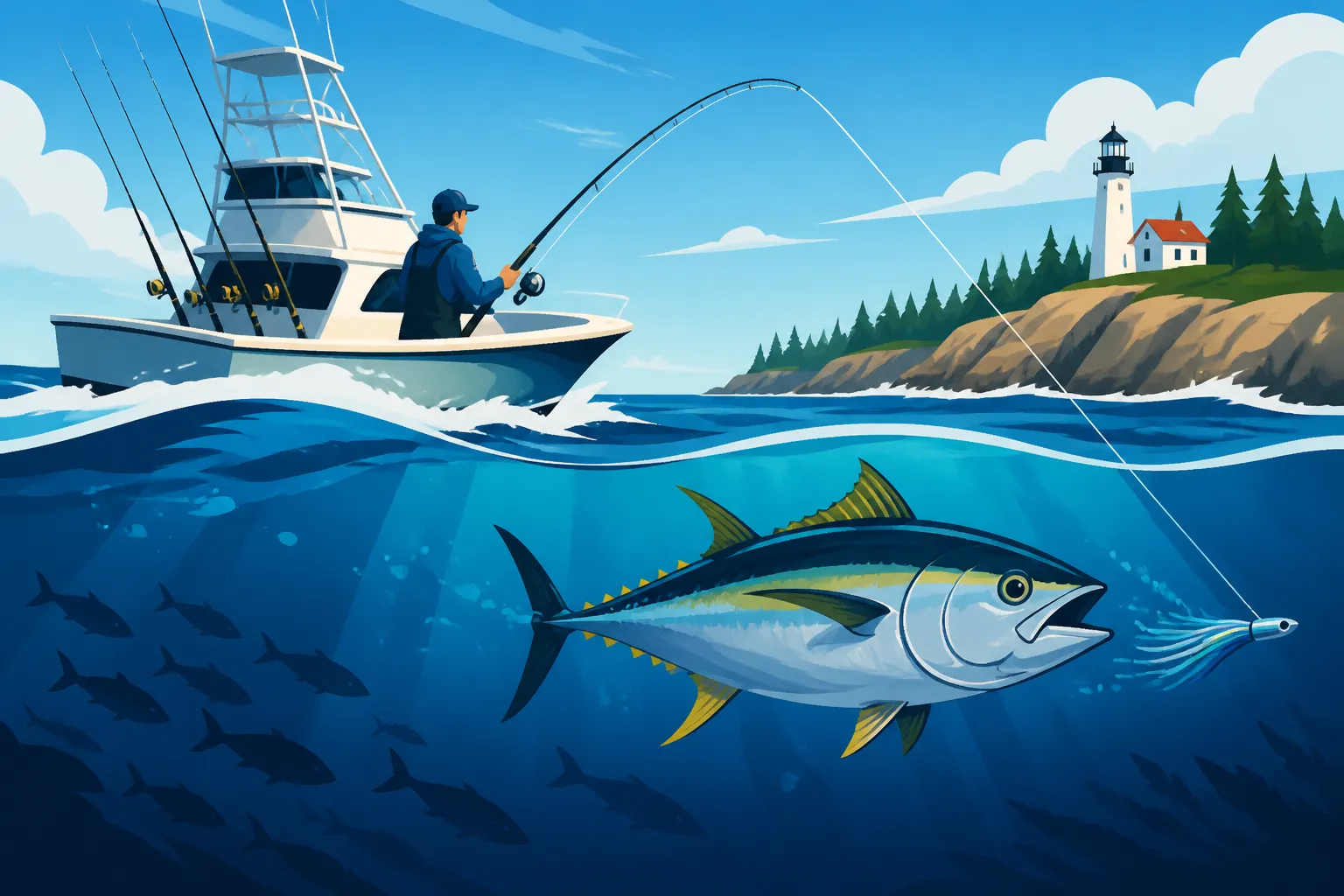
The undisputed king of Maine's deep sea trolling scene is the Bluefin Tuna. These powerful fish are highly migratory and chase baitfish along the coast throughout the summer and fall. Landing a giant Bluefin is often a once-in-a-lifetime experience for many anglers, known for their incredible speed and stamina. Trolling for them involves heavy tackle and a strong back, but the reward is immense. You might also encounter Sharks, such as Mako or Thresher sharks, which are impressive fighters and can put on an aerial show when hooked. While not typically targeted for meat, they offer an incredible sportfishing opportunity. Keep in mind that specific permits are required for retaining highly migratory species like Bluefin tuna and certain sharks. You'll want to review the federal regulations in addition to state rules, which are covered in our comprehensive guide, Maine Fishing Regulations Explained.
Beyond the truly pelagic giants, you can also target large groundfish by employing different trolling strategies. Species like Cod, Haddock, and Pollock often congregate around underwater structures, ledges, and wrecks. While typically caught by jigging or bottom fishing, some anglers successfully troll for them using heavier lines and downriggers to get baits deep. These fish make excellent table fare and provide a steady bite, making them a great target, especially if the tuna aren't cooperating. Knowing your target species helps immensely in planning your trip, from the gear you'll need to the locations you'll focus on. To understand what fish you might encounter on your offshore adventure, check out our article on Best Fish to Catch in Maine.
Essential Gear for Deep Sea Trolling
Deep sea trolling isn't like casting a worm in a pond. The fish are bigger, the forces at play are immense, and your gear needs to be up to the task. Skimping on tackle here isn't just a risk to your catch; it can be a safety concern, leaving you outmatched and potentially frustrated.
Rods, Reels, and Lines Built for Battle
For deep sea trolling, your setup needs to be robust. We’re talking about heavy-duty rods, often in the 50 to 80-pound class, or even 130-pound class for giant Bluefin. Many anglers prefer stand-up rods with curved butts, which allow for better leverage and comfort when fighting a fish from a harness. The quality of your rod's guides and gimbal is paramount, as they'll endure immense pressure. Don't underestimate the strain a powerful fish can put on your gear – a weak link will inevitably fail at the most inconvenient moment.
Matching your rod with a high-quality lever-drag reel is crucial. These reels are designed for brute strength, with high line capacities, smooth drag systems, and powerful gears. Brands like Shimano, Penn, and Daiwa are popular choices among seasoned offshore anglers. You'll want a reel that can hold at least 500-800 yards of heavy monofilament or braided line. When it comes to fishing line, many choose to spool their reels with heavy braided line (e.g., 80-130 lb test) for its incredible strength and minimal stretch, then add a long monofilament top shot (100-200 yards of 80-150 lb test mono) to provide some stretch and make the line less visible to fish. The mono top shot also offers better abrasion resistance against the fish's body or rough structures. When assembling your ultimate deep sea trolling setup, you can often find a wide selection of these specialized rods, reels, and lines on platforms like Amazon, making it convenient to gear up from home.
The Right Lures and Baits for Maine's Giants
The bait or lure you present is your direct communication with the fish, and offshore, it needs to be enticing enough to trigger a strike from a powerful predator. Variety and presentation are key.
For tuna, skirted lures are incredibly popular. These come in various shapes, sizes, and colors, designed to imitate baitfish like mackerel, squid, or even small tuna. Often, a combination of colors that mimic local bait is effective. Common choices include chuggers, bullet heads, and jet heads, which create different actions and disturbances in the water. Spreader bars and daisy chains are also highly effective, creating the illusion of a school of baitfish, which can draw in aggressive tuna. These setups typically involve multiple lures or teasers connected in a chain, with a larger "stinger" lure at the end that the fish are meant to strike. Don't forget cedar plugs, simple yet incredibly effective wooden lures that dart and weave erratically, mimicking distressed bait. For purchasing these specialized deep-sea lures and baits, many experienced anglers turn to online retailers like Amazon for competitive pricing and a vast selection.
When it comes to natural bait, nothing beats fresh. Mackerel, menhaden (pogies), and herring are prime choices for tuna and sharks. These can be trolled live or rigged dead, often pulled behind a lead-head jig or within a skirted lure for added appeal. Rigging natural bait correctly is an art form in itself, ensuring it swims naturally and doesn't spin, which can deter a wary fish. Having a variety of both artificial lures and natural baits allows you to adapt to changing conditions and fish preferences, which can vary wildly from day to day or even hour to hour.
Specialized Trolling Equipment
Beyond rods, reels, and lures, several pieces of specialized equipment elevate deep sea trolling from a basic operation to a finely tuned, strategic pursuit. These tools help you control your spread, present baits effectively, and ultimately, find the fish.
Downriggers are invaluable for presenting baits at precise depths, especially when fish are holding deep due to temperature or bait location. They use heavy weights and a release clip system to lower your lure to a specific depth, detaching when a fish strikes. Outriggers extend from the sides of your boat, allowing you to run multiple lines far out from the boat's wake, creating a wider and more natural-looking spread. This also helps prevent tangles when fighting a fish. For keeping track of your position, depth, and potential targets, a reliable sonar/fish finder and GPS plotter are non-negotiable. Modern units offer incredible detail, allowing you to see bait balls, thermoclines, and even individual fish arches. Understanding how to interpret what your fish finder is telling you is crucial, a skill that shares similarities with reading sonar for freshwater fishing, as discussed in How to Read a Fish Finder for Ice Fishing.
Planer boards are another tool used to spread lines out wide from the boat, particularly useful in conditions where outriggers might not be as effective or on smaller boats. They drag through the water, pulling your line to the side. Other essential items include heavy leaders (fluorocarbon or monofilament, often 100-300 lb test), swivels, snap swivels, and a robust tackle box to keep everything organized. Don't forget a large, insulated cooler for your catch and plenty of ice to keep it fresh. Each piece of gear plays a critical role in increasing your chances of success and ensuring you're prepared for whatever the deep blue throws your way.
Mastering Deep Sea Trolling Techniques
Successfully trolling in the deep sea is more than just dragging lines behind a boat. It's a calculated dance of speed, spread, and observation, constantly adapting to the ocean's ever-changing moods.
Setting Up Your Spread
The goal of a trolling spread is to present multiple baits or lures at varying depths and distances behind your boat, creating the illusion of a school of baitfish or individual prey. A well-executed spread maximizes your chances of a strike and minimizes tangles.
Typically, you'll start with flat lines run directly off the stern, often with a heavier lure or natural bait. These usually run closest to the boat, in the prop wash, which can often be an enticing zone. Next, come the short rigger lines, extended out from your outriggers, usually positioning lures just beyond the prop wash. Finally, the long rigger lines are run furthest back, often 100-200 feet behind the boat, creating the widest and deepest part of your surface spread. For species like tuna, you might also employ a center rigger line, often referred to as the "shotgun" lure, run directly down the middle, far behind the boat, as a lonely, easy target. Utilizing downriggers allows you to add lines much deeper in the water column, often below the main surface spread, targeting fish that might be holding at specific depths, such as a thermocline or a deep bait ball. Staggering your baits in this way not only covers more water but also makes your spread look more natural, like a dynamic school of bait. Each lure should have its own "action," and when viewed from above, the spread should look like a chaotic yet appealing meal.
Optimal Trolling Speeds and Patterns
Trolling speed is perhaps one of the most critical variables, as it directly affects the action of your lures and how they appeal to different species. There's no single "perfect" speed; it's about constant adjustment based on conditions and target fish.
For most pelagic species like tuna and sharks, trolling speeds generally range from 5 to 8 knots. However, this can vary. Faster speeds (7-9 knots) are often used for bluefin tuna, especially with skirted lures designed to be pulled quickly. Slower speeds (4-6 knots) might be more effective when using natural baits or when fish are less aggressive. Wind, current, and even the type of lure can all influence the effective speed. Pay attention to how your lures are performing in the water – are they swimming naturally? Are they blowing out of the water? Adjust your speed until the lures exhibit their intended action. In terms of trolling patterns, simply going in a straight line isn't always the most effective. Making S-turns or figure-eights can be incredibly effective. As your boat turns, the lures on the inside of the turn slow down and drop, while the lures on the outside speed up and rise. This change in speed and depth can often trigger a hesitant fish to strike. Also, pay attention to any underwater structure you might be marking on your sonar; making passes over and around these features can increase your chances significantly.
Reading the Ocean and Finding the Fish
The ocean is a dynamic environment, and the most successful deep sea anglers are those who can "read" it, interpreting subtle signs to pinpoint where the fish are likely to be.
Your sonar and fish finder are your eyes below the surface. Learn to distinguish between bait balls, thermoclines (layers of water with different temperatures), and larger fish arches. Baitfish often congregate around these thermoclines, and predators will follow. Look for temperature breaks on your plotter; even a degree or two difference can concentrate bait and game fish. Offshore, current lines where two currents meet can create distinct color changes in the water and accumulate debris, attracting baitfish. Above the surface, bird activity is a huge indicator. Diving birds, especially gulls, terns, and shearwaters, often signal baitfish being pushed to the surface by feeding predators. Look for flocks working together or individual birds making repeated dives. Floating debris, like Sargassum weed lines or random flotsam, can create miniature ecosystems, providing shelter for baitfish and drawing in larger predators. Even changes in water color or texture can tell a story. Learning to combine these observations with your knowledge of typical fish behavior is what separates good anglers from great ones. The sea is always speaking; you just need to learn its language.
Safety and Regulations Offshore
Heading far offshore is an amazing experience, but it comes with inherent risks. Being prepared for anything and understanding the rules of the road (and the ocean) is paramount. Don't let the thrill override common sense and safety protocols.
Navigational Prowess and Weather Awareness
The sheer vastness of the ocean can be disorienting, and far from shore, help is not always immediate. Before you even think about dropping a line, you need to be confident in your navigational skills. This includes understanding your boat's capabilities, knowing how to read charts (both paper and electronic), operating your GPS plotter effectively, and having backup navigation tools. Always let someone on shore know your float plan – where you're going, when you expect to return, and who is on board.
Weather awareness is absolutely critical. Maine's offshore weather can change rapidly and dramatically. What starts as a calm, sunny morning can quickly turn into heavy seas and dense fog. Constantly monitor marine weather forecasts before and during your trip. Have a reliable VHF radio, satellite phone, or other communication device for emergencies. Ensure your boat is equipped with all necessary safety gear, including life jackets for everyone on board, flares, a first-aid kit, and an EPIRB (Emergency Position Indicating Radio Beacon) or PLB (Personal Locator Beacon). Don't just carry these items; know how to use them. Pushing your luck when the weather looks questionable is a gamble that's rarely worth taking, as the conditions offshore can become treacherous very quickly. While not exactly the same, understanding general weather patterns and their impact, as explored in How Wind Affects Lake Fishing, can provide a foundational understanding that applies to ocean conditions.
Understanding Offshore Fishing Regulations
Fishing in Maine's offshore waters means navigating a complex web of state and federal regulations. It's not enough to just have your state fishing license; you need to understand the specifics for the species you're targeting, especially when dealing with highly migratory species.
For general recreational saltwater fishing in Maine, residents and non-residents alike need to register with the Maine Saltwater Fishing Registry Guide. This is a critical first step. However, once you venture beyond state waters (typically 3 nautical miles from shore), you enter federal waters, where federal regulations often supersede state rules, especially for certain species. If you plan to target Bluefin Tuna or specific Shark species, you will need a Highly Migratory Species (HMS) Angling Permit issued by NOAA Fisheries. These permits are crucial and come with specific reporting requirements. Ignorance of the law is not an excuse, and federal fines can be substantial.
Furthermore, each species has specific size limits and bag limits. For example, Bluefin Tuna have complex slot limits and seasonal closures that vary by permit category. Knowing the current rules for Maine Striped Bass Season and Limits can give you a baseline understanding, but offshore species often have even more stringent and variable regulations. Check the latest federal regulations handbook (available online) before every trip, as these rules can change frequently. Don't rely on old information or hearsay. Being a responsible angler means not only catching fish but also understanding and adhering to all conservation efforts and legal requirements. When it comes to knowing precisely how many fish you can keep, our guide on Maine Fish Bag Limits Guide is a valuable resource, though federal rules for offshore species will also apply.
Advanced Trolling Tactics and Tips
Once you've got the basics down, there's always more to learn and refine in the world of deep sea trolling. These advanced tactics can make the difference between a good day and a truly epic one.
The Art of the Teaser
Teasers are perhaps one of the most underutilized, yet highly effective, tools in a deep sea troller's arsenal. Their purpose isn't to catch fish, but rather to attract them into your spread, stimulating their predatory instincts and drawing them closer to your baited hooks.
A teaser essentially simulates a larger school of baitfish or a struggling prey item, creating a commotion and visual spectacle in the water. Popular teasers include dredges (large, umbrella-like setups with dozens of artificial or natural baits that create a massive visual profile), daisy chains (a series of small lures or squids strung together), and splash bars (a rigid bar with multiple bird-like lures that skip and splash on the surface). These teasers are typically run unbaited and positioned in key areas of your spread, often closer to the boat than your baited lines, to "raise" fish up to the surface. When a large predator like a tuna or marlin sees this commotion, it often approaches the teaser first, thinking it's a prime feeding opportunity. As it gets closer, it then spots your baited lures swimming alongside the teaser and switches its focus, leading to a strike. The trick is to keep the teaser in the water even after a strike, as it can often entice other fish in the school to follow the hooked fish, potentially leading to multiple hookups. Mastering the art of teaser placement and retrieval can significantly boost your success rate.
Fighting and Landing Big Game
Hooking into a massive tuna or shark offshore is an adrenaline rush like no other. But the real challenge begins after the strike: fighting and landing that powerful fish safely and efficiently. This is where your heavy-duty gear and your own physical endurance are truly put to the test.
For large Bluefin, stand-up fighting gear with a harness and kidney belt is essential. This transfers much of the strain from your arms and back to your legs and core, allowing you to endure longer fights. The key to fighting big game is to apply constant pressure, pumping the rod to gain line when the fish isn't running, and letting the smooth drag do its job when it is. Don't try to muscle the fish if it's running hard; let it take line, then recover it when it pauses. Communication between the angler, the captain, and the crew is vital, especially when maneuvering the boat to keep the fish off the props or out of other lines. For truly massive fish, a fighting chair might be necessary. Once the fish is alongside the boat, the crew will work to gaff it (if retaining) or leader it to the boat for release. This stage is particularly dangerous, as a green (unspent) fish can cause serious injury. Always follow the captain's instructions and ensure everyone on board knows their role.
Post-Catch Care and Conservation
Whether you plan to keep your catch or release it, how you handle the fish after it's landed is crucial for its survival or for the quality of its meat. Responsible angling includes ethical treatment of the fish at every stage.
If you're practicing catch and release, especially for highly migratory species or those with strict bag limits, the goal is to minimize stress and injury to the fish. Fight the fish quickly and efficiently, use barbless hooks if possible, and avoid removing the fish from the water if it's a large species. If you must bring it aboard for a quick photo, keep it wet and support its body horizontally. Use de-hooking tools to remove hooks quickly and gently. For more detailed guidance on preserving the health of released fish, consult our guide on Catch and Release Best Practices in Maine. If you intend to harvest your catch, particularly for tuna, proper post-catch care is essential for meat quality. Immediately after landing, the fish should be bled (by cutting the gills or tail), then quickly placed on ice in a large cooler. Rapid cooling inhibits bacterial growth and preserves the flavor and texture of the meat. A large tuna might require hundreds of pounds of ice to chill properly. Taking these steps not only respects the fish but also ensures that if you're taking it home, it will be at its peak quality. Always prioritize conservation and respect for the resource, ensuring that Maine's deep sea fishing opportunities remain vibrant for generations to come.
| Species Targeted | Typical Trolling Speed (Knots) | Preferred Lure/Bait Types | Common Depths |
|---|---|---|---|
| Bluefin Tuna | 5-8 (sometimes 9-10) | Skirted lures (chuggers, jet heads), spreader bars, daisy chains, natural bait (mackerel, herring) | Surface to 100 ft |
| Mako/Thresher Shark | 4-7 | Large natural baits (tuna chunks, mackerel), skirted lures | Surface to 50 ft |
| Cod/Haddock | 2-4 | Jigging spoons, large soft plastics, natural bait (clams, worms) | 100 ft + (near bottom) |
| Pollock | 3-6 | Jigs, flashy spoons, tube lures, natural bait (strips of baitfish) | 50-200 ft |
Disclaimer
Please remember that fishing regulations, conditions, and best practices can change. Always consult the latest rules and safety information from the Maine Department of Inland Fisheries and Wildlife (MDIFW) and NOAA Fisheries before heading out on any fishing trip. The advice in this guide is for informational purposes only and should not replace professional guidance or personal judgment.