Best Practices for Releasing Trout
There's nothing quite like the thrill of a Maine trout hitting your line, whether it's a feisty brook trout in a clear mountain stream or a powerful landlocked salmon in a vast lake. Many of us are passionate about catch-and-release, wanting to ensure these magnificent fish thrive for future generations. But the honest truth is, not every released fish makes it, and it can be heartbreaking to see a fish struggle after you've let it go. This comprehensive guide is dedicated to providing you with the best practices for releasing trout and salmon, ensuring your efforts lead to genuinely successful outcomes and contribute to the health of Maine's incredible fisheries.
Understanding Trout Vulnerability and Stress Factors
Before we even talk about specific techniques, it’s vital to understand what makes trout and salmon so susceptible to harm during the catch-and-release process. These aren't hardy bottom-dwellers; they are finely tuned creatures that react intensely to stress. Knowing their vulnerabilities helps us approach every release with the care they deserve.
The Delicate Nature of Trout
Trout and landlocked salmon, while powerful fighters, are surprisingly delicate when it comes to human interaction. Their skin is covered in a protective slime coat, a vital barrier against disease and parasites. Even a brief moment of dry hands or contact with rough surfaces can strip away this layer, leaving them vulnerable. Their gills are also incredibly fragile, essential for extracting oxygen from the water. Any significant damage here can severely impact their ability to breathe, especially after an exhausting fight. Internally, their organs can be easily damaged by deep-set hooks or rough handling, leading to internal bleeding or organ failure that might not be immediately apparent. Understanding this inherent fragility is the first step toward becoming a truly responsible catch-and-release angler.
Common Stressors During a Catch
Think about it from the fish's perspective: suddenly, it's hooked, fighting for its life, and being pulled from its natural environment. This experience is incredibly stressful. Prolonged fights, especially on light tackle, can exhaust a fish to the point of no return. Imagine running a marathon and then being held underwater – that's often what a long fight feels like to a trout. Air exposure, even for a few seconds for a quick photo, can cause significant damage to their gills and internal organs, as they are designed to breathe water, not air. The warm temperatures of summer waters exacerbate this stress, as warmer water holds less oxygen, making it harder for an exhausted fish to recover. Knowing these stressors helps us minimize them. For instance, in warmer months, it might be wiser to focus on early morning or late evening fishing when water temperatures are lower, or target different species.
Environmental Impacts on Survival
The environment plays a huge role in a released fish's survival. Water temperature is perhaps the most critical factor. Cold, well-oxygenated water is a trout's best friend. As water temperatures rise, the amount of dissolved oxygen decreases, and fish become more stressed and have a harder time recovering from a fight. This is why many experienced anglers practice "hatchery rules" for wild trout in warmer conditions, opting not to fish at all when water temperatures climb into the mid-60s Fahrenheit or higher. Furthermore, areas with strong currents or heavy boat traffic can be challenging for a disoriented fish trying to recover. They might struggle to hold their position or become easy prey for opportunistic predators like gulls or larger fish. Be mindful of these environmental conditions and always prioritize the fish's well-being over extending your fishing time. Understanding Reading Water Temperature for Maine Trout can give you a significant advantage in making ethical decisions.
Gearing Up for a Gentle Release
Successful catch-and-release isn't just about technique; it starts before you even cast your line. Having the right tools and making smart tackle choices can dramatically improve a fish's chances of survival. It’s about being prepared for that moment when you connect with a fish, ensuring you can handle it swiftly and safely.
Essential Tools for Quick and Safe Unhooking
Having the right tools at your fingertips is paramount. First, a good pair of long-nosed pliers or, even better, a specialized de-hooking tool is non-negotiable. These allow you to remove hooks quickly without putting your hands or the fish's delicate structure at risk. You can find excellent options on Amazon, often designed specifically for anglers. Second, a net is invaluable, but not just any net. Look for a net with a rubberized, knotless mesh. Traditional knotted nylon nets can abrade a fish's slime coat, damage fins, and even get tangled in their gills. A rubberized net, on the other hand, is much gentler on the fish and far less likely to tangle hooks, speeding up the entire process. Consider a compact measuring board if you plan to measure your catch; avoid laying the fish on rough surfaces.
Choosing the Right Tackle to Minimize Harm
Your choice of tackle has a direct impact on the fish's welfare. For artificial lures, crimping down the barbs on your hooks is perhaps the simplest and most effective measure you can take. Barbless hooks make removal incredibly easy, reducing tissue damage and stress. Many anglers even go a step further and replace treble hooks on lures with single, barbless hooks. While this might occasionally result in a lost fish, the trade-off in fish welfare is significant. When it comes to bait fishing, using circle hooks can dramatically reduce gut hooking, as they are designed to hook in the corner of the fish's mouth. If you’re unsure which lures are best, check out Best Lures for Maine Open Water Fishing for some gentle options. For those targeting specific species like brook trout, understanding Best Bait for Brook Trout and how to present it effectively yet safely is key.
Preparing Your Landing Zone
Before you even start fishing a spot, take a moment to consider how you'll land and release a fish. If you're wading in a stream, identify a calm, shallow area with minimal current where you can safely cradle the fish. If you're fishing from a boat, ensure your net is easily accessible and clear any clutter in the boat that could injure a thrashing fish. The goal is to minimize the time the fish spends out of water and reduce the chances of it flopping onto a hard surface. Have your pliers or de-hooker ready and within reach, not buried at the bottom of your tackle box. This foresight and preparation are crucial steps to ensuring a smooth, low-stress release. Remember, the less time a fish is out of its element, the better its chances of survival.
The Art of Minimal-Contact Handling and Release
Once you've hooked a fish, the clock starts ticking. Every second counts, and every touch matters. The goal here is to handle the fish as little as possible, keeping it in its natural environment throughout the entire process. This "minimal-contact" philosophy is the cornerstone of responsible catch-and-release.
Keeping the Fish in the Water
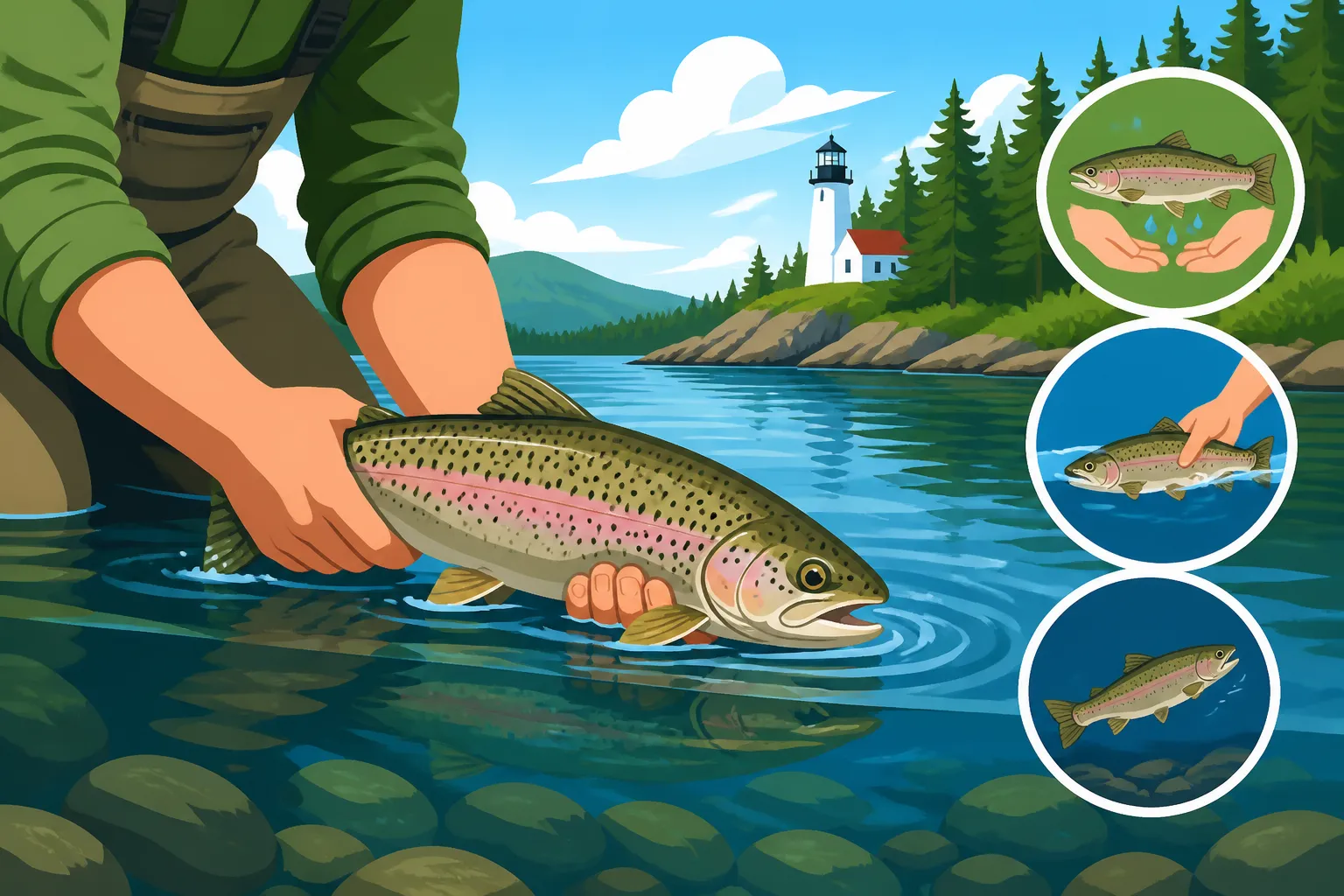
This is the golden rule of catch-and-release. Whenever possible, keep the fish fully submerged. If you're wading, bring the fish to your net while it’s still in the water, or simply grasp it gently in the water. If you need to remove it from the net, keep its head and gills submerged while you work. If you absolutely must lift it for a quick photo (and truly, quick is the operative word), support its entire body horizontally with wet hands. Never hold a fish vertically by the jaw or gills, as this can cause severe internal damage, especially to larger trout and salmon. A quick dip back in the water between shots can help. For an in-depth look at this, our guide on How to Handle Fish Without Hurting Them provides excellent visual explanations. Remember, the fish’s health is more important than a perfect picture.
Master the De-Hooking Process
Once the fish is in your net or cradled gently in the water, it's time to remove the hook. With barbless hooks, this is usually a simple flick of the wrist with your pliers. For barbed hooks, use your de-hooking tool or pliers to firmly grasp the bend of the hook and back it out the way it went in. If the hook is deeply embedded and cannot be removed without causing further damage, the best course of action is often to simply cut the line as close to the hook as possible. The hook will often rust out or be expelled by the fish's body over time. Don't yank or twist aggressively; work slowly and deliberately. If you're struggling, take a deep breath. A few extra seconds of careful work are better than a rushed, damaging removal.
Safe Release Checklist
| Practice | Do This | Avoid This |
|---|---|---|
| Landing | Use a rubberized, knotless net. Bring fish into shallow, calm water. | Use knotted nylon nets. Drag fish onto rocks/shore. |
| Handling | Keep fish in water as much as possible. Use wet hands if lifting. Support horizontally. | Hold fish vertically by jaw/gills. Use dry hands. Squeeze or drop fish. |
| Unhooking | Use long-nosed pliers or de-hooker. Cut line if hook is deep. | Rip or tear out deeply embedded hooks. Twist hook excessively. |
| Air Exposure | Minimize to absolute bare minimum (seconds for quick photo, if at all). | Prolonged air exposure for photos, hook removal, or showing off. |
| Revitalization | Gently hold fish facing upstream in current. Look for fin movements. | Toss fish back immediately. Release in turbulent water. |
| Gear Choice | Use barbless hooks. Replace treble hooks with single barbless. Circle hooks for bait. | Use barbed treble hooks on lures. Use J-hooks for bait if not paying attention to bites. |
Revitalization Before Release
After the hook is out, the fish needs a moment to regain its strength. Hold the fish gently upright in the water, preferably in a calm current with its head facing upstream. Allow water to flow over its gills. Don't rock the fish back and forth; this doesn't help it breathe and can actually do more harm than good. Instead, just hold it steady. You’ll know it's recovering when it starts to move its fins, particularly its tail, and tries to swim away from your grasp. Only release it when it can confidently swim off under its own power. If it rolls over or struggles, continue to support it. This revitalization process is critical, especially after a long fight or in warmer water. Patience here makes all the difference between a fish that swims away to fight another day and one that becomes easy prey or perishes later.
Avoiding Common Mistakes and Maximizing Survival
Even with the best intentions, it's easy to make mistakes that compromise a fish's survival. Being aware of these pitfalls and understanding the finer points of post-release ethics will help you elevate your catch-and-release game and truly contribute to conservation.
Recognizing When a Fish Won't Make It
Sometimes, despite your best efforts, a fish might be too injured or too exhausted to survive. This is a tough reality to face. Signs of a fish unlikely to make it include severe bleeding from the gills, being unable to right itself after several minutes of revitalization, or floating belly-up even after apparent recovery. In such cases, if local regulations allow, it might be more humane to harvest the fish, provided it meets the Maine Fish Bag Limits Guide and other Maine Fishing Regulations Explained. This prevents the fish from dying slowly or becoming scavenged while still alive. It's a difficult decision, but a responsible one when faced with a mortally wounded fish. The goal is always to maximize survival, and sometimes that means making a hard call.
Post-Release Ethics and Observation
Your responsibility doesn't end the moment the fish swims away. A true commitment to catch-and-release involves ensuring the fish has truly recovered. Take a moment to observe the released fish. Does it swim strongly into deeper water, or does it flounder near the surface? Does it dart away when approached, or does it seem disoriented? If it's struggling, you might need to re-engage the revitalization process, gently scooping it back up and holding it again. Avoid casting into the immediate area where you just released a fish; give it space to fully recover without further stress. This post-release observation and mindful angling are part of the larger ethical framework that governs our interactions with Maine's aquatic life. Whether you're targeting Brook Trout Fishing in Maine or Landlocked Salmon Fishing in Maine, these ethics apply universally.
Educating Yourself and Others
The best way to ensure the future of Maine's incredible trout and salmon fisheries is through education and shared knowledge. Continue to learn, read articles like this, watch instructional videos (many available on Amazon, covering specific techniques and gear), and talk to experienced anglers. Share your knowledge with others, especially newer anglers or children. Demonstrate proper catch-and-release techniques when fishing with friends or family. Encourage the use of barbless hooks and rubberized nets. When you encounter someone using poor handling practices, approach them respectfully and offer guidance, rather than criticism. By fostering a community that values the health of our fish, we ensure that the joy of reeling in a beautiful Maine trout will be there for generations to come. Your passion for fishing can be a powerful force for conservation.
Disclaimer
This article is for general informational purposes only and does not constitute professional advice. Laws, prices and regulations vary by location and change over time. Consult a qualified professional for guidance on your specific situation.