Fly Fishing for Beginners in Maine
Stepping into the world of fly fishing can feel a little like trying to learn a new language while simultaneously attempting a complex dance. For many beginners in Maine, the sheer volume of gear, terminology, and delicate techniques can be incredibly daunting, leading to frustration before they even make their first cast. But don't let that deter you! This guide is here to demystify fly fishing, breaking it down into manageable steps so you can confidently cast a line in Maine's beautiful waters.
The Unique Allure of Fly Fishing in Maine's Waters
There's something undeniably magical about fly fishing, especially here in Maine. It's more than just catching fish; it's an immersive experience that connects you deeply with nature, demanding patience, observation, and a subtle artistry. Unlike conventional spinning or baitcasting, fly fishing uses the weight of the line, rather than the lure, to propel your presentation, allowing for delicate imitations of insects that fish naturally feed on. This nuanced approach opens up a whole new dimension of angling.
Why Maine is a Fly Fishing Paradise
Maine truly offers a diverse playground for fly anglers, from its wild, tumbling brooks to its serene, crystal-clear lakes. We're blessed with an abundance of cold-water species like our native brook trout, landlocked salmon, and lake trout (or togue, as we call them up here). The variety of ecosystems means you can spend one day wading a small stream for eager brookies and the next casting large streamers on a vast lake for a trophy salmon. It's this natural variety, combined with the solitude and raw beauty of the landscape, that makes Maine an ideal place to learn and grow as a fly fisherman. The changing seasons also present different opportunities, from the eager bites of spring to the stunning backdrop of fall fishing.
Understanding the Fly Fishing Mindset
Fly fishing isn't just about the gear; it's about adopting a different mindset. It requires a keen eye for detail, understanding insect hatches, reading the water, and learning to mimic nature's bounty. You'll find yourself paying more attention to the subtleties of the current, the ripple of an insect taking flight, or the way light filters through the trees. This meditative aspect is a huge part of its appeal, offering a quiet escape from the hustle and bustle of everyday life. It teaches you patience and resilience, as every missed cast or lost fish becomes a learning opportunity, refining your technique and deepening your connection to the sport.
Essential Gear for the Beginner Fly Angler
One of the biggest hurdles for new fly anglers is figuring out what gear they actually need. It can feel like walking into a foreign language textbook, but don't worry, we'll break down the basics. The good news is, you don't need to break the bank to get started; many reputable brands offer excellent entry-level equipment.
Choosing Your First Fly Rod and Reel Setup
For beginners, a good starting point is usually a 5-weight or 6-weight fly rod, typically between 8.5 to 9 feet in length. This weight is versatile enough for most freshwater fishing in Maine, whether you're chasing brook trout in smaller streams or casting for landlocked salmon on larger ponds. A 5-weight is a fantastic all-around choice. Look for a rod with a medium-fast action, which offers a good balance of responsiveness for casting and forgiveness for beginners learning the rhythm. Many starter kits bundle a rod, reel, line, and even a leader, which can be an excellent and cost-effective way to begin. Brands like Orvis, Redington, and even some options found on Amazon offer great value for beginners.
The reel, honestly, is often just a glorified line holder for trout and salmon fishing, especially when you're starting out. You'll want one that's appropriately balanced with your rod (meaning it feels good in your hand, not too heavy or too light at either end). A basic large arbor reel is usually sufficient. Focus on matching the reel to the rod's weight (e.g., a 5/6 weight reel for a 5-weight rod). The key is that the drag system works smoothly, though for most freshwater trout, you'll rarely rely heavily on it.
Understanding Fly Line, Leaders, and Tippet
This is where things can get a little confusing, but let's simplify. Your fly line is the thick, weighted line that allows you to cast your fly. For most freshwater applications, a weight-forward (WF) floating line is the standard. The "weight-forward" taper helps with casting distance and turning over your leader, while "floating" means it stays on the surface, which is ideal for dry flies and most nymphing techniques. Make sure your line weight matches your rod's weight (e.g., WF-5-F for a 5-weight rod).
Attached to your fly line is the leader, a tapered piece of monofilament or fluorocarbon that gradually gets thinner, creating a nearly invisible connection to your fly. A 9-foot tapered leader with a 4X or 5X tippet end is a good general choice for trout. The "X" designation refers to the tippet's diameter, with higher numbers indicating thinner, less visible line. Finally, the tippet is the thinnest section of line you tie directly to your fly. It's often added to the end of your leader to extend its life and allow you to change flies without shortening your main leader too quickly. Carrying a spool of 4X and 5X tippet is smart, as you can replace the sacrificial end of your leader as needed. This gradual reduction in line thickness is crucial for a delicate, natural presentation of your fly.
| Item | Recommended for Beginners | Why it's important |
|---|---|---|
| Fly Rod | 5-weight or 6-weight, 8.5-9 ft, medium-fast action | Versatile for various freshwater fish and techniques; easier for learning casting mechanics. |
| Fly Reel | Basic large arbor, matched to rod weight | Holds line, provides smooth drag for fighting fish (less critical for smaller trout). |
| Fly Line | Weight-forward (WF) floating, matched to rod weight | The weight of this line carries your fly; floating for surface presentations and most nymphing. |
| Leader | 9-foot tapered, 4X or 5X tippet end | Invisible connection to fly, helps transfer casting energy, ensures delicate presentation. |
| Tippet | Spools of 4X and 5X monofilament | Extends leader life, allows for fly changes, fine-tunes presentation based on water conditions and fish spookiness. |
| Waders/Boots | Stockingfoot waders & separate wading boots | Keeps you dry and provides traction; essential for wading into streams and rivers. |
| Vest/Pack | Lightweight vest or chest pack | Organizes flies, tools, and accessories for easy access. |
| Net | Small, rubber-mesh landing net | Helps land fish safely, minimizes harm to fish for catch-and-release. |
Other Essential Accessories and Apparel
Beyond the rod, reel, and line, a few other items will make your fly fishing experience much more comfortable and productive. Waders are almost a necessity for most stream and river fishing in Maine, allowing you to get into the water where the fish are without getting soaked. Stockingfoot waders combined with separate wading boots offer the best combination of comfort, durability, and traction. Don't skimp on quality wading boots; good grip is paramount for safety on slippery riverbeds.
You'll also need a fishing vest or chest pack to carry your flies, tippet spools, nippers (for cutting line), forceps (for removing hooks), and a floatant (for dry flies). A small, rubber-mesh landing net is also a fantastic investment, as it protects the fish if you plan on practicing Catch and Release Best Practices in Maine. Polarized sunglasses are absolutely critical for seeing through the water's glare, helping you spot fish and submerged obstacles. And, of course, don't forget your Maine Fishing License Guide! These licenses are required for most anglers and you can often buy them online or at local sporting goods stores.
Mastering Basic Fly Casting Techniques
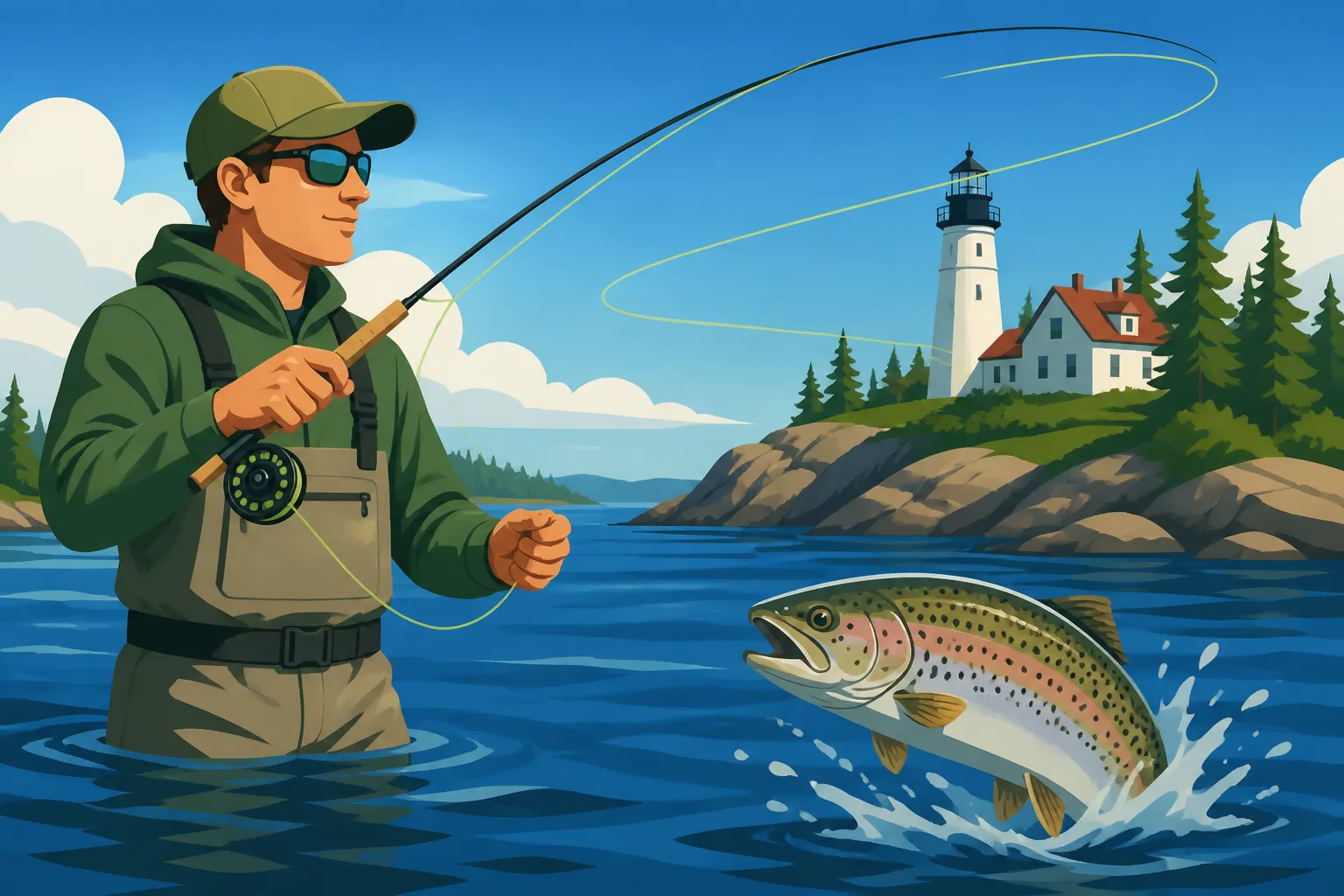
The cast is often what intimidates beginners the most in fly fishing. It looks so graceful and effortless when an experienced angler does it, but don't be fooled—it takes practice. Think of it less as a forceful throw and more like painting with your rod.
The Fundamental Overhead Cast
The overhead cast is the bread and butter of fly fishing, and it's where every beginner should start. It's a simple back-and-forth motion that uses the flexibility of the rod to load and unload energy into the fly line.
- The Ready Position: Stand comfortably, holding the rod grip firmly but not tightly. Your elbow should be close to your body, and the rod tip should be pointing low, towards the water, with about 10-15 feet of fly line extended in front of you. This initial setup is crucial for a smooth pickup.
- The Pickup/Back Cast: With a smooth, accelerating motion, lift the rod straight up, bringing it to about the 1 o'clock position (just past vertical). Stop abruptly. The energy of this stop will send the line unrolling behind you. Resist the urge to look behind you; instead, feel the line load the rod. This short, crisp stop is what creates the "loop" in your line.
- The Pause: This is perhaps the most critical part. You must wait for the line to fully unroll behind you. Watch the line out of your peripheral vision, or simply count to yourself ("one-thousand-one, one-thousand-two" for shorter casts). Rushing this step is the most common beginner mistake and results in a tangled mess.
- The Forward Cast: Once the line is fully extended behind you, begin your forward stroke. Accelerate the rod forward, stopping sharply at about the 10 o'clock position (well above horizontal). This stop will propel the line forward, unrolling gracefully towards your target.
- The Follow-Through: Allow the rod tip to follow the line's path, bringing it gently down towards the water as the line settles. This helps ensure a soft presentation.
Practice this rhythm in your backyard without a fly, just a piece of yarn tied to your leader. Focus on smooth acceleration and abrupt stops, feeling the rod bend and unbend. Consistency is key, and you'll find that once the basic rhythm clicks, everything else becomes much easier.
Essential Casting Tips for New Anglers
Beyond the basic steps, a few tips can dramatically improve your early casting efforts. First, always think about casting the line, not the fly. The fly is just along for the ride. The weight of the fly line is what you're manipulating. Second, keep your wrist stiff and use your forearm and shoulder for power. Too much wrist movement leads to wide, inefficient loops and tangles. Imagine you're shaking hands with someone above you on the backcast and then pointing to them on the forward cast.
Third, remember the "power snap" or the abrupt stop at the end of both your backcast and forward cast. This sudden halt sends a shockwave down the rod, transferring energy into the line. Without it, your line will just flop. Fourth, don't try to cast too far too soon. Focus on accuracy and presentation with shorter casts, and the distance will naturally come with practice. Many beginners try to force distance, which usually leads to poorer casting and more frustration. Lastly, if you're consistently getting tangles, known as "wind knots," it's often a sign you're rushing your pause on the backcast. Slow down, let the line extend, and you'll see a huge improvement.
Getting Started with Fly Selection and Presentation
Once you've got a handle on the casting, the next step is understanding what fly to use and how to present it. This is where the detective work of fly fishing truly begins, as you try to "match the hatch" – imitate what the fish are currently eating.
Decoding Basic Fly Categories
Flies are generally categorized by what they imitate and how they're fished:
- Dry Flies: These flies float on the surface of the water and imitate adult insects (mayflies, caddisflies, stoneflies) that have emerged from the water or fallen onto it. Fishing a dry fly is incredibly exciting, as you get to see the fish rise and take your offering. Popular beginner dry flies include the Elk Hair Caddis, Adams, and Parachute Adams. These are often great for stream fishing, especially during active insect hatches.
- Nymphs: Nymphs imitate the immature, aquatic stage of insects that live on the bottom of rivers and lakes. Most of a trout's diet consists of nymphs, making them incredibly effective. Nymphs are fished subsurface, often with a strike indicator to detect bites. Common beginner nymphs are the Hare's Ear, Pheasant Tail, and Prince Nymph. Learning How to Nymph Fish for Trout effectively can significantly increase your catch rate.
- Streamers: These flies imitate baitfish, leeches, or other larger prey. Streamers are typically larger and weighted, fished by stripping them through the water to mimic a swimming action. They are excellent for targeting larger, more aggressive fish like landlocked salmon, bigger trout, and smallmouth bass. Woolly Buggers, Clouser Minnows, and Grey Ghosts are great starting points.
- Wet Flies: Less common for absolute beginners but worth knowing, wet flies imitate drowned or emerging insects just below the surface. They are typically fished downstream and across the current, allowing them to swing and rise.
For starters, having a small selection of each category will prepare you for a variety of situations. Don't feel pressured to buy hundreds of different patterns; a dozen or two well-chosen flies will serve you well.
Presenting Your Fly Naturally
The most beautiful cast in the world is useless if your fly doesn't look natural to the fish. This is where presentation comes in.
- Drag-Free Drift: For dry flies and nymphs, a drag-free drift is paramount. This means your fly should float downstream at the same speed as the current, just like a natural insect would. If your line is pulling your fly faster or slower than the current, it creates "drag," which looks unnatural to fish. Learning to mend your line (making small adjustments to keep slack out or add slack in) is essential for achieving a drag-free drift.
- Reading the Water: Before you cast, observe the water. Look for seams where faster and slower currents meet, eddies behind rocks, or deeper pools. Fish often hold in these areas to conserve energy and ambush prey. Also, watch for rising fish, which will tell you they are actively feeding on the surface. Understanding Reading Water Temperature for Maine Trout and other environmental cues can also help you pinpoint where fish might be holding.
- Stealth and Approach: Fish are incredibly wary, especially in clear Maine waters. Approach the water slowly and quietly. Wear drab clothing that blends into the background, and avoid casting a shadow over the water. Often, the best approach is to cast upstream and allow your fly to drift down to where you suspect fish are holding. Always remember that the first cast is usually your best chance, so make it count.
- Setting the Hook: When a fish takes your fly, resist the urge to violently yank the rod. For dry flies, a gentle, upward sweep of the rod tip is usually sufficient. For nymphs or streamers, a sideways sweep or simply tightening the line with your non-dominant hand can be more effective. Practice the "trout set" – a smooth, quick lift of the rod.
Finding Beginner-Friendly Fly Fishing Spots in Maine
Maine is brimming with fantastic fly fishing opportunities, but knowing where to start can be overwhelming. The key is to look for accessible, less pressured waters where fish are more forgiving of a less-than-perfect cast.
Accessible Rivers and Streams for Trout
Many of Maine's smaller rivers and streams are perfect for the budding fly angler, especially when targeting brook trout. These waters often have good public access, whether through state parks, public land, or designated fishing access points. For instance, sections of the Crooked River near Naples, parts of the Presumpscot River, or even the Royal River offer decent access and hold trout. The Magalloway River and Kennebago River in Western Maine are renowned for their wild brook trout populations, though they can be a bit more challenging and require more travel. Always check local regulations, as some areas may be "fly-fishing-only" or "catch-and-release" to protect native populations. The Maine Fishing Regulations Explained guide is an invaluable resource for this.
When exploring these areas, look for slower-moving pools, undercut banks, and areas with structure like submerged logs or rocks. These provide cover and feeding lanes for trout. Early mornings and late evenings are often the most productive times, especially in warmer months. Remember that fish tend to be more active in cooler water, so focus on spring-fed areas or oxygenated riffles. If you're looking for more specific guidance, consider hiring a Maine Fly Fishing Guides for a day to get a localized introduction.
Lakes and Ponds for Landlocked Salmon and Bass
While streams are classic fly fishing territory, don't overlook Maine's vast network of lakes and ponds. These offer opportunities for larger species like landlocked salmon and smallmouth bass, which can be incredibly fun on a fly rod.
Lakes like Sebago Lake, Moosehead Lake, and the Belgrade Lakes are famous for their populations of landlocked salmon, brook trout, and smallmouth bass. While these can be vast, many have excellent shore access or public boat launches. For salmon, you might be looking at trolling streamers with a sink-tip line from a canoe or kayak, or targeting them in river mouths during their spawning runs. For smallmouth bass, shallower rocky areas, submerged structure, and weed beds are prime targets. Poppers and larger streamers can be incredibly effective for bass, offering explosive topwater action. Smallmouth bass are particularly aggressive and often more forgiving, making them a great target for beginners. To find specific details on limits and seasons, check out the Maine Landlocked Salmon Bag Limits and Maine Bass Fishing Limits by Zone guides.
When fishing lakes, pay attention to depth contours and structure using a fish finder if you have access to a boat. For shore fishing, look for points, drop-offs, and areas where feeder streams enter the lake. Don't forget that many smaller, unheralded ponds across Maine can offer fantastic, quiet fishing for brook trout, often with less competition. You can often find decent fishing gear for both lake and river applications on Amazon, making it easy to get what you need delivered right to your door.
Understanding Maine-Specific Regulations and Etiquette
Before you even make your first cast, it's absolutely crucial to understand the rules and unwritten codes of conduct that apply to fishing in Maine. This ensures a safe, legal, and respectful experience for everyone, and helps preserve our precious fisheries for generations to come.
Key Maine Fishing Regulations for Fly Anglers
Maine has some specific regulations that are important for fly anglers to be aware of. First and foremost, you need a valid Maine Fishing License Guide. These licenses are required for most anglers over the age of 16 and can be purchased online through the Maine Department of Inland Fisheries and Wildlife (MDIFW) website, or in person at many town offices and sporting goods stores. Fees vary for residents and non-residents, and there are different options like annual, 3-day, 7-day, or 15-day licenses, perfect for visitors.
Beyond the license, pay close attention to the specific regulations for the body of water you intend to fish. Maine uses a system of general law and special regulations. General law applies to most waters, but many specific lakes, ponds, and sections of rivers have "special regulations" that supersede the general law. These special regulations might dictate specific fishing methods (e.g., "fly fishing only"), tackle restrictions (e.g., "single hook artificial lures only"), bag limits, length limits, or even seasonal closures. Always consult the most current Maine Fishing Regulations Explained booklet, available online or at license agents, before you go. This booklet is your bible for responsible angling in Maine. Understanding the Maine North Zone vs South Zone Fishing Rules is also critical, as regulations can differ significantly depending on the geographical zone.
Practicing Ethical and Respectful Angling
Beyond the written laws, there's a strong tradition of angling etiquette in Maine that every fly fisherman should embrace.
- Respect Other Anglers: If someone is already fishing a stretch of river or a prime spot on a pond, give them plenty of space. Don't crowd them or wade directly into their fishing area. Move upstream or downstream far enough so you won't interfere with their fishing. A friendly nod or "hello" is always appreciated, but avoid loud conversations or excessive splashing.
- Practice Catch and Release Responsibly: Many waters in Maine, especially those managed for wild trout, are designated "catch and release only." Even in waters where you can keep fish, practicing responsible catch and release helps sustain fish populations. Handle fish gently with wet hands, keep them in the water as much as possible, use a rubber-mesh net, and quickly remove the hook with forceps. Avoid touching their gills or eyes. For more detailed advice, refer to our guide on Catch and Release Best Practices in Maine.
- Leave No Trace: Pack out everything you pack in, including all trash, broken line, and discarded tippet. Leave the area cleaner than you found it. This simple principle is fundamental to preserving Maine's natural beauty.
- Respect Private Property: Always be aware of property lines and access points. Just because you can fish a river doesn't mean you can trespass across private land to get there. Stick to public access points and trails.
- Be Mindful of Wildlife: You're in their home! Observe wildlife from a respectful distance and avoid disturbing them. This includes nesting birds, deer, moose, and other creatures that share the Maine wilderness.
By adhering to these rules and embracing responsible practices, you not only ensure your own enjoyable experience but also contribute to the long-term health and accessibility of Maine's incredible fly fishing resources.
Disclaimer
The information provided in this guide is for general informational purposes only and is subject to change. Always consult the official Maine Department of Inland Fisheries and Wildlife (MDIFW) regulations booklet and website for the most current and accurate fishing laws, licensing requirements, and specific waterbody rules before planning any fishing trip. Fishing conditions and regulations can vary significantly.