Is Striped Bass Fishing Legal in Federal Waters Off Maine?
It's a common dilemma for anglers heading out onto the vast, beautiful waters off Maine: when you're chasing that elusive striped bass, just where do the rules change? The boundary between state and federal waters can feel like a blurry line, and many a seasoned fisher has scratched their head trying to figure out if that striper they just reeled in, a few miles offshore, is actually legal to keep. This guide is here to untangle the complexities of striped bass fishing regulations in federal waters, helping you navigate the rules and enjoy your time on the water without worry.
Understanding State Versus Federal Waters for Anglers
The ocean isn't just one big, unregulated playground. For fishing purposes, especially concerning certain species, it's divided into distinct zones, each with its own set of rules and governing bodies. Understanding these boundaries is the first critical step to being a compliant and responsible angler.
Defining the Lines: State Territorial Waters
Imagine drawing a line three nautical miles out from Maine's coastline. This imaginary boundary marks the extent of Maine's territorial waters, often simply referred to as "state waters." Within this zone, generally speaking, the State of Maine's Department of Inland Fisheries and Wildlife (IFW) and Marine Resources (DMR) have primary jurisdiction over fishing activities. This means that rules regarding licenses, bag limits, size restrictions, and seasons for most species, including striped bass, are set and enforced by state authorities.
For recreational anglers targeting striped bass, most of the action, and therefore most of the regulations you need to know, falls squarely within these state waters. Whether you're casting from a pier in Portland, wading the flats in Phippsburg, or trolling a tube and worm near the mouth of the Kennebec River, you'll be adhering to the Maine Fishing Regulations Explained as laid out by the state. This is where you'll find details on specific slot limits, daily bag limits, and season dates that dictate what you can and cannot keep.
Venturing into the Exclusive Economic Zone (EEZ)
Beyond that three-nautical-mile line lies the Exclusive Economic Zone (EEZ), often referred to as "federal waters." This vast area extends up to 200 nautical miles from shore. Here, the federal government, primarily through the National Oceanic and Atmospheric Administration (NOAA) Fisheries and the New England Fishery Management Council, takes the lead on managing marine resources. Different species fall under different management plans, and the rules can become significantly more complex, especially for migratory fish that cross these imaginary lines.
For species like groundfish (cod, haddock), tuna, and highly migratory pelagics (sharks, marlin), federal rules often supersede or complement state rules once you're outside that 3-mile boundary. However, striped bass presents a unique case. While they are certainly migratory and can be found beyond the 3-mile mark, their management, particularly for recreational harvest, has been historically handled in a way that often leads to specific prohibitions in federal waters to reinforce conservation efforts. It's not a simple switch where state rules end and federal rules automatically allow harvest.
The Nuance of Striped Bass Management: Why It's Tricky
Striped bass are an iconic game fish along the Atlantic coast, known for their powerful fights and delicious flesh. Their migratory nature means they traverse the waters of many states, making singular state-by-state management challenging. This is where inter-state and federal cooperation become crucial, and why the rules can feel like a tangled net.
Atlantic States Marine Fisheries Commission's Role
The Atlantic States Marine Fisheries Commission (ASMFC) is the linchpin in striped bass management. This interstate compact, formed by 15 Atlantic coastal states, develops and implements fishery management plans for species that migrate across state lines. For striped bass, the ASMFC's management plan sets coast-wide conservation goals and outlines specific regulations (like slot limits, bag limits, and seasons) that each member state is then required to implement within their own waters.
Maine, as a member of the ASMFC, adopts these recommendations into its own Maine Fishing Regulations Explained. This coordinated effort aims to manage the striped bass stock sustainably across its entire range, from Maine down to North Carolina. The idea is that consistent regulations prevent anglers from simply moving to a different state or zone to exploit more liberal rules, which would undermine conservation efforts. This shared responsibility is why you see similar (though not identical) regulations for striped bass up and down the coast, all striving towards the same conservation objectives.
Federal Regulations and Striped Bass Prohibitions
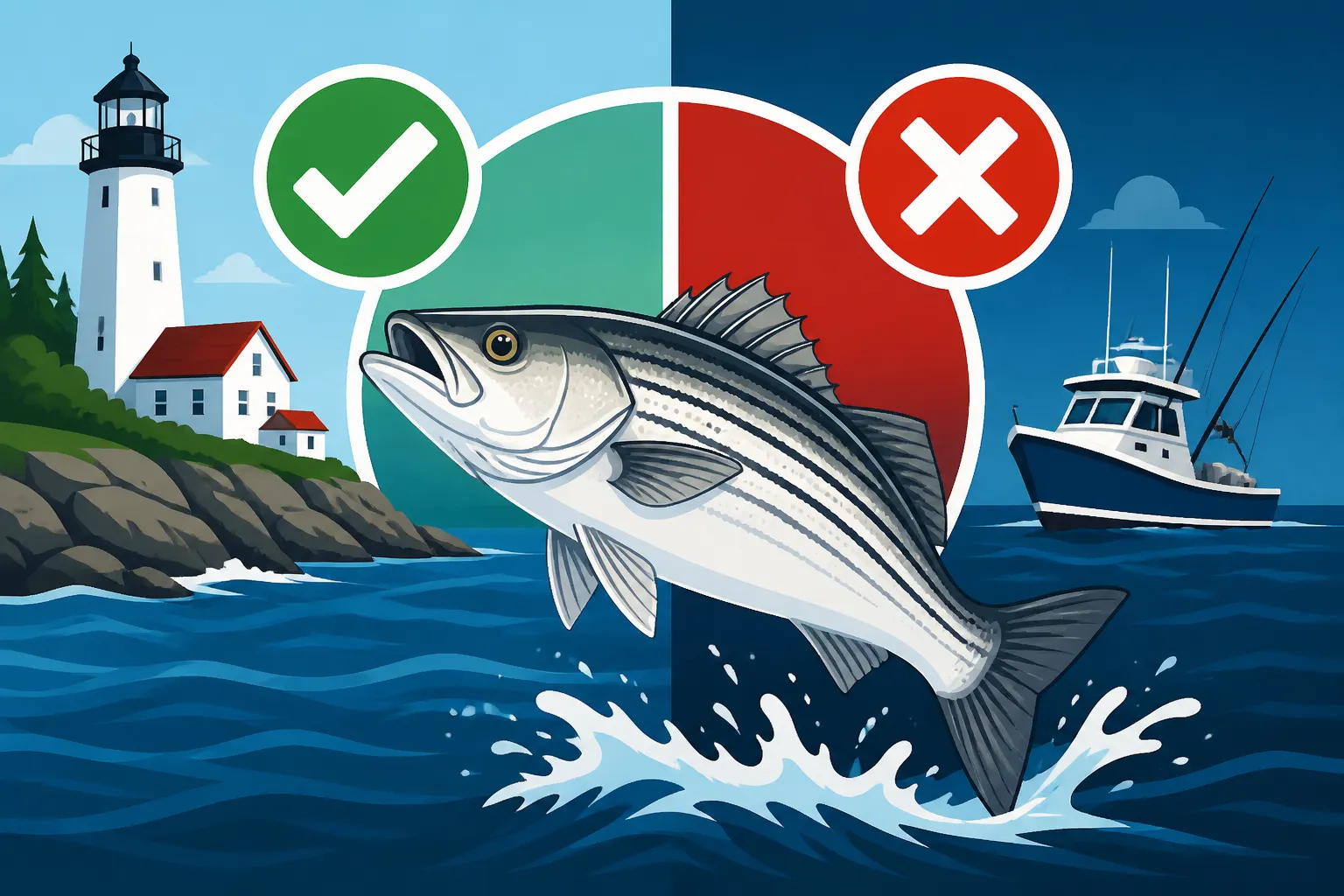
So, is striped bass fishing legal in federal waters off Maine? For recreational anglers, the simple answer for possession is generally no.
While striped bass do swim in federal waters (beyond 3 nautical miles), NOAA Fisheries, in cooperation with the ASMFC, has maintained a federal closure for recreational striped bass possession in the Exclusive Economic Zone (EEZ). This means that if you are fishing in federal waters, you are not allowed to retain or possess any striped bass, regardless of its size. If you catch one in federal waters, it must be immediately released. This prohibition is a crucial conservation measure. It ensures that anglers cannot skirt state regulations by simply going a few miles offshore. The intent is to protect the species and simplify enforcement by creating a clear, no-take zone in federal waters for recreational striped bass.
This closure also applies to any striped bass caught in state waters that an angler then attempts to transport through federal waters. For instance, if you catch your limit within Maine's state waters and then decide to run your boat 5 miles offshore to fish for tuna, you are technically in violation if you still have striped bass on board while in the EEZ. This rule is designed to prevent ambiguity and ensure the integrity of the management plan. It's a tough pill for some anglers to swallow, but it's vital for the health of the stock.
Practical Implications for Maine Striped Bass Anglers
Navigating these regulations can feel like a maze, especially when you're out on the water, eager to drop a line. But with a clear understanding and a few practical tips, you can enjoy your striped bass fishing confidently and compliantly.
Staying Compliant: What Every Angler Needs to Know
The golden rule for striped bass in Maine is this: assume all legal recreational harvest happens within state waters (0-3 nautical miles from shore), and no possession is allowed in federal waters (beyond 3 nautical miles).
- Know Your Position: If you're heading offshore, even just a few miles, invest in reliable GPS equipment. Many modern fish finders and chartplotters clearly display the 3-mile line. You can also purchase detailed NOAA nautical charts, readily available on Amazon, that visually depict these crucial boundaries. Knowing exactly where you are at all times is your best defense against accidental violations.
- Check Current Regulations: Fisheries rules can change. Before each season, always consult the official Maine Department of Marine Resources (DMR) website or pick up a current copy of the Maine Fishing Law Book Where to Get One. These resources will confirm the latest Maine Striped Bass Season and Limits, including slot limits and bag limits, specifically for state waters. Remember, these state regulations are your primary guide for keeping a striped bass.
- Release in Federal Waters: If you're beyond the 3-mile line and accidentally hook into a striped bass, enjoy the fight, but be prepared to release it immediately and unharmed. Familiarize yourself with proper Catch and Release Best Practices in Maine to give the fish the best chance of survival.
- Licensing: Always ensure you have your Maine Saltwater Fishing Registry Guide completed, as required for saltwater fishing in Maine, even if you’re fishing within state waters. This is separate from a freshwater license you might need for inland fishing. The registry is free and essential.
Gear, Tactics, and Mindset for Coastal Striper Fishing
Given the federal prohibition, most dedicated striped bass fishing in Maine naturally focuses on the prolific inshore and nearshore state waters. This is where you'll find the most consistent action and where you can legally target and retain these magnificent fish.
Focus your efforts in estuaries, bays, and along the coastline. Popular spots include the rocky shores of Acadia National Park, the tidal flows of the Kennebec River, or the vast stretches of Casco Bay. These areas are teeming with baitfish, attracting stripers throughout their migratory season. For gear, a medium-heavy spinning or baitcasting setup is ideal, capable of handling powerful runs.
When it comes to lures and bait, choices abound. Soft plastics, topwater plugs, and minnow imitations are highly effective. For more specific guidance, check out resources like Best Lures for Striped Bass in Maine. Many anglers also find success with live bait like mackerel, eels, or menhaden, which can be incredibly effective in certain situations. The key is to understand the fish's behavior and feeding patterns in these inshore environments. Mastering techniques like How to Read Tides for Striped Bass Fishing will significantly increase your success.
Common Misconceptions and Avoiding Costly Mistakes
The intricate web of fishing regulations, particularly when federal and state jurisdictions meet, often gives rise to misunderstandings. These can, unfortunately, lead to violations that carry significant penalties.
The "I Caught it Outside" Fallacy
One of the most dangerous misconceptions is believing that if you catch a striped bass in federal waters, you can somehow "legalize" it by bringing it back into state waters. This is absolutely incorrect and a common source of fines. The federal prohibition on possession means that if you are fishing beyond the 3-mile line, any striped bass you catch must be immediately released. You cannot keep it, no matter its size or if it meets Maine's slot limit. Transporting a striped bass, dead or alive, through federal waters when you're recreating is also typically a violation.
Enforcement officers are well aware of this common misunderstanding. They patrol both state and federal waters, and if you're found with striped bass onboard in the EEZ, or if there's evidence you harvested them there, you could face hefty fines and confiscation of your catch and gear. It's simply not worth the risk. Understanding What Happens If You Fish in Maine Without a License? gives you an idea of the seriousness of fisheries violations, and these federal rules are no different.
Resources for Clarification
The best way to avoid mistakes is to be proactive about understanding the rules. Don't rely on dockside rumors or outdated information.
- Official Websites: Bookmark the Maine Department of Marine Resources (DMR) and the Maine Department of Inland Fisheries and Wildlife (IFW) websites. These are the official sources for state regulations. For federal rules, NOAA Fisheries provides comprehensive information.
- Local Tackle Shops: Your local bait and tackle shop owners are often goldmines of current, practical information. They deal with these rules daily and can offer insights into local nuances and recent changes. They often have copies of the regulation books.
- Charts and GPS: As mentioned, a good GPS unit with up-to-date charts is invaluable. Many fishermen download marine mapping apps to their phones or tablets, which, when paired with a quality external GPS receiver, can show your precise location relative to the state/federal line. You can find robust, waterproof options on Amazon to keep your electronics safe.
- Fish and Wildlife Wardens: If you are truly unsure about a specific regulation, never hesitate to contact your local Maine Fish and Wildlife Warden. They are there to educate and enforce, and they'd much rather answer a question than write a ticket. Getting clarity directly from them is the most reliable way to ensure you're compliant.
- Understanding the "General Law": For freshwater fishing, Maine has a "General Law" that applies unless specific waters have special regulations. While saltwater rules are slightly different, the concept of a baseline rule with exceptions is similar. Familiarize yourself with the Maine General Fishing Law Definition Explained for a broader understanding of how Maine approaches its fisheries management.
By respecting these boundaries and prohibitions, you not only avoid penalties but also contribute to the long-term health of the striped bass population, ensuring future generations can enjoy the thrill of catching this incredible fish in Maine's beautiful coastal waters.
Comparative Look: State vs. Federal Waters for Recreational Striped Bass
To help visualize the difference, here's a quick comparison:
| Feature | Maine State Waters (0-3 Nautical Miles) | Federal Waters (3-200 Nautical Miles – EEZ) |
|---|---|---|
| Governing Authority | Maine Department of Marine Resources (DMR) | NOAA Fisheries (Federal) |
| Recreational Fishing | Generally allowed, subject to state bag, size, and season limits. | Closed to recreational possession of striped bass. |
| Possession of Stripers | Permitted, if within state limits. | Not permitted. Any striped bass caught must be released. |
| Relevant Regulations | Maine's specific Maine Fish Bag Limits Guide, slot limits, seasons. | Federal EEZ regulations for striped bass (often a blanket closure). |
| Enforcement | Maine Marine Patrol, Maine Fish & Wildlife Wardens | U.S. Coast Guard, NOAA Law Enforcement |
| Why the Difference? | State management for local stocks and ASMFC compliance. | Conservation measure to protect stock, simplify enforcement, and prevent circumvention of state laws. |
Disclaimer
Please note that fishing regulations are subject to change. While every effort has been made to provide accurate and up-to-date information in this guide, it is ultimately the angler's responsibility to consult the most current official regulations from the Maine Department of Marine Resources (DMR) and NOAA Fisheries before heading out on the water. This article is for informational purposes only and should not be considered legal advice.