How to Fish a Jig for Bass
There's nothing quite like the thump of a bass hitting a jig, but let's be honest, for many anglers, especially those new to the game or venturing into different techniques here in Maine, jigs can feel a bit… mysterious. You see seasoned pros landing monster largemouth and smallmouth on these odd-looking contraptions, and you wonder if it's black magic or just a finely honed skill. This comprehensive guide is here to demystify the art of fishing a jig for bass, giving you the confidence and know-how to make it a go-to in your tackle box for those finicky Maine bass.
Understanding the Bass Jig: More Than Just a Hook and Weight
At its core, a bass jig is a lead head with a hook, dressed up to entice fish. But like any good Maine dish, it's the subtle ingredients and preparation that make all the difference. Understanding the various components and why they exist is your first step to mastering this incredibly versatile lure.
The Anatomy of a Bass Jig
Every part of a bass jig plays a crucial role in its presentation, action, and effectiveness. Let's break down the key elements you'll encounter on your next trip to the tackle shop, whether you're browsing the aisles of Kittery Trading Post or scrolling through options on Amazon.
First, you have the head. This is typically made of lead (though tungsten options are gaining popularity for their density and smaller profile) and comes in a bewildering array of shapes.
- Flipping Jigs usually have a compact, pointed head, often bullet-shaped, designed to slip through dense cover like lily pads, heavy grass, or brush piles with minimal snagging. Their weed guards are often stout to match.
- Football Jigs boast a wider, football-shaped head that's perfect for crawling over rocky bottoms, shell beds, or gravel flats. The wider profile helps them maintain contact with the bottom and prevents them from rolling over, offering a fantastic feel for structure.
- Swim Jigs often have a more hydrodynamic, bullet, or bladed head, designed for smooth movement through the water column, mimicking baitfish. The line tie on a swim jig is typically higher up on the head, which helps with a horizontal retrieve.
- Arkie Jigs are a classic, versatile choice with a flat bottom and a more rounded head. They're excellent for pitching, casting, or even light swimming, making them a great all-around jig.
Next is the hook. This is obviously critical, and not all jig hooks are created equal. You'll find jigs with light wire hooks for finesse presentations and super heavy-duty hooks capable of pulling a monster bass from the thickest cover. A sharp, strong hook is non-negotiable for success, especially when you're punching through the jaw of a big smallmouth or largemouth.
Then there's the skirt. This is the "flash" of the jig, typically made of silicone, rubber, or sometimes natural hair. The skirt pulsates and flares in the water, mimicking the legs of a crawfish, the fins of a baitfish, or even the tendrils of vegetation. Skirt colors and patterns are endless, from natural greens and browns to vibrant blues and purples. The way a skirt moves is vital; some are designed for subtle undulations, while others offer a more aggressive flare.
Finally, most bass jigs feature a weed guard. This is usually a bundle of stiff plastic or fiber strands positioned in front of the hook point. Its purpose is to deflect snags from wood, rocks, or weeds, allowing your jig to go where other lures fear to tread. The stiffness and density of the weed guard can vary greatly depending on the jig's intended use, from sparse, soft guards for open water to thick, rigid ones for heavy cover punching.
Choosing the Right Weight and Color
Selecting the right weight and color for your jig can feel overwhelming, but it boils down to matching the conditions you're fishing in. Think about what the bass are seeing and how they're behaving.
For weight, consider these factors:
- Water Depth: Shallower water (less than 10 feet) often calls for lighter jigs, perhaps 1/4 to 3/8 ounce. Deeper water (10-25 feet or more, common when targeting smallmouth on lakes like Sebago Lake) will require heavier jigs, from 1/2 ounce up to 1 ounce or even more, to reach the bottom efficiently and maintain contact.
- Cover Density: When you're fishing sparse cover or open water, lighter jigs offer a more natural fall. But if you're trying to punch through dense mats of weeds or penetrate a thick brush pile, a heavier jig (like a 3/4 or 1 ounce) will break through the vegetation better.
- Wind and Current: On windy days, or when fishing in current on rivers like the Penobscot, a heavier jig helps you keep control and feel the bottom. A light jig will get swept away, making it impossible to present effectively.
- Rate of Fall: Sometimes, bass prefer a slow, enticing fall. Other times, a fast, aggressive drop can trigger a reaction strike. Experiment with different weights to see what the fish are responding to.
Color is often debated, but a good rule of thumb is to "match the hatch" or match the conditions:
- Natural Colors (Greens, Browns, Black/Blue): These are your workhorse colors. In clear water, subtle greens like pumpkin or green pumpkin, and natural crawfish patterns, are often best. Black and blue is a universally effective color, especially in slightly stained or darker water, and it's a fantastic choice for mimicking crawfish or even leeches.
- Baitfish Colors (White, Chartreuse, Shad patterns): For swim jigs, you'll want colors that imitate the local baitfish. Whites, shad patterns, and sometimes a touch of chartreuse can be deadly, especially when bass are actively feeding on schools of bait.
- Contrast Colors (Black/Red, Dark Blue): In very stained or muddy water, or on dark, overcast days, a high-contrast color like black and blue or black and red can help fish locate your lure. The silhouette against the sky can be more visible.
- Matching Trailers: Always consider the color of your trailer when choosing your jig. Often, you want the trailer to complement or slightly contrast the jig skirt to create an appealing profile.
Essential Gear for Jig Fishing Success in Maine
Having the right equipment can make or break your jig fishing experience. While you can certainly get by with general purpose gear, optimizing your rod, reel, and line will drastically improve your casting accuracy, sensitivity, and ability to land those feisty Maine bass.
Rod and Reel Pairings for Jigs
When it comes to jig fishing, you're looking for a setup that provides power for hooksets, sensitivity for detecting subtle bites, and control for precise presentations.
For rods, a medium-heavy (MH) to heavy (H) power rod with a fast or extra-fast action is generally ideal.
- Power refers to the rod's lifting strength. You need sufficient power to drive a heavy hook into a bass's jaw, especially with thicker wire hooks found on many jigs. It also helps you steer fish away from heavy cover.
- Action describes where the rod bends. A fast or extra-fast action means the rod bends primarily in the tip section, which translates to superior sensitivity for feeling bites and structure, and quicker hooksets.
Most anglers opt for rods in the 6'10" to 7'6" range. Shorter rods (around 6'10" – 7'0") are great for accurate flipping and pitching in tight quarters, common when you're targeting docks or overhanging trees along the shoreline. Longer rods (7'2" – 7'6") offer more casting distance and better leverage for longer casts or pulling big bass out of dense vegetation. For fishing jigs on deeper structures, a longer rod can also help you take up more line on the hookset. Brands like St. Croix or Fenwick offer excellent options that Maine anglers trust.
When it comes to reels, a baitcasting reel is almost universally preferred for jig fishing.
- Gear Ratio: A reel with a moderate to high gear ratio (6.1:1 to 7.5:1) is typically best. A moderate ratio gives you good power for slow retrieves and fighting fish, while a faster ratio allows you to quickly reel in slack line after a cast or when a fish makes a run towards you. Having the ability to quickly pick up slack is crucial for effective jig fishing, as many bites happen on the fall or as you're starting your retrieve.
- Spool Capacity: Ensure your reel has enough line capacity for your chosen line type and fishing situation. While most jig casts aren't exceptionally long, having enough line to handle powerful runs is important.
Matching your rod and reel for balance is key. A balanced setup will reduce fatigue and enhance your ability to feel subtle bites. Consider visiting a local tackle shop to hold different combinations and find what feels right in your hands.
Line Choices and Their Impact
The line connecting you to your jig is your direct link to the fish. Choosing the right line impacts sensitivity, abrasion resistance, and casting performance.
- Fluorocarbon Line: This is a fan favorite for jig fishing, and for good reason. Fluorocarbon is incredibly sensitive, allowing you to feel even the slightest tap or change in bottom composition. It also has very low stretch, which translates to better hooksets. Critically, fluorocarbon is nearly invisible underwater, a huge advantage in clear Maine waters, making your jig appear more natural. It's also quite abrasion resistant, which is a plus when fishing around rocks or wood. Typical breaking strengths range from 12 to 20 pounds, depending on the cover and size of fish you're targeting. For a balance of sensitivity and strength, 15-pound test is a great starting point for many jig applications.
- Braided Line: For truly heavy cover situations, such as punching through dense mats or flipping into thick brush, braided line is king. Its zero-stretch property offers unparalleled sensitivity and instant hooksets, and its incredible strength and abrasion resistance mean you can often muscle fish out of places fluorocarbon or mono would break. However, braid is highly visible, so it's almost always paired with a fluorocarbon leader (typically 12-25 pounds, 18-24 inches long) to maintain a stealthy presentation. This combination offers the best of both worlds: the power and sensitivity of braid with the invisibility of fluorocarbon. Braid in the 30-50 pound test range is common for heavy jigging.
Monofilament line is generally not recommended for jig fishing due to its high stretch, which hinders sensitivity and hooksetting power.
Trailer Selection: The Secret Sauce
The jig trailer isn't just an afterthought; it's often the most critical component of your jig presentation. It adds bulk, action, and profile, mimicking the natural prey bass are feeding on. Think of it as the "dessert" that seals the deal. You can find a vast selection of trailers, from simple grubs to highly articulated crawfish imitations, on sites like Amazon.
Here are the main types and their uses:
- Crawfish Imitations: These are perhaps the most popular trailers, as crawfish are a primary food source for bass in many Maine lakes and ponds. They come in various sizes and designs, from compact chunks to larger, more realistic craws with flapping claws. The key is to match the size and color to local crawfish species. When you're dragging or hopping a jig along the bottom, a craw trailer is often irresistible.
- Paddletail Grubs or Swimmer Baits: For swim jigs, trailers with a paddletail or a boot tail create a swimming action that perfectly imitates a baitfish. These are fantastic for covering water, especially when bass are cruising or suspended. They add a subtle thumping vibration that can attract fish from a distance.
- Straight-Tail Grubs or Chunks: These offer a more subtle action. A straight-tail grub might be used when you want minimal movement, or when fish are being finicky. Pork chunks, while less common now, used to be a staple for their durability and natural movement. Soft plastic chunks can still be effective, adding bulk without excessive action.
- Worms or Senko-style Baits: Sometimes, a small worm or a cut-down Senko-style bait can be used as a trailer, offering a very subtle, quivering action on the fall or when paused. This can be great for pressured fish or colder water.
When choosing a trailer, consider:
- Size: Match the size of the trailer to your jig and the size of the forage. A smaller jig might call for a smaller, more compact trailer.
- Color: Often, you want the trailer color to complement or slightly contrast the jig skirt. For example, a black and blue jig might be paired with a matching black and blue craw, or a green pumpkin jig with a brown or orange craw to imitate a molting crawfish.
- Action: Think about how you want the jig to move. A flapping craw trailer will provide more erratic movement on the retrieve, while a paddletail offers a consistent swimming action.
Mastering Jig Presentations for Maine Bass
Once you have your gear dialed in, it's time to learn how to present your jig effectively. Jig fishing is less about speed and more about feel and methodical retrieves. Each jig type and situation calls for a slightly different approach.
Flipping and Pitching: Precision in Heavy Cover
Flipping and pitching are stealthy, short-distance casting techniques designed to present a jig (or other heavy bait) quietly and accurately into tight, heavy cover without spooking the fish. These techniques are absolutely essential for targeting bass that are buried deep in structure along Maine's lakeshores or riverbanks, especially during warmer months.
-
Flipping: This is a very short-range presentation, typically used for targets within 10-20 feet of the boat or shore. You don't actually cast; instead, you swing the bait underhand like a pendulum, letting out line with your non-reeling hand.
- Preparation: Hold the rod up, let out enough line so the jig hangs about halfway down the rod.
- Swing: Swing the rod tip forward, letting the jig swing out towards your target.
- Control: As the jig swings, let line slip through your non-reeling hand, guiding the jig to drop softly into the cover. Your goal is a quiet entry, like dropping a feather.
- Retrieve: Once the jig hits the bottom, typically within thick cover, give it a few subtle hops or shakes with the rod tip. If no bite, lift it gently and "flip" it to the next spot.
-
Pitching: This technique is similar to flipping but allows for a slightly longer, more controlled cast, usually for targets 20-50 feet away.
- Preparation: Let the jig hang 1-2 feet below the rod tip.
- Swing: With one hand on the rod handle and the other holding the jig (or the line just above it), make a short, controlled underhand swing.
- Release: Release the jig (or the line) at the peak of the swing, letting the rod's loading propel the lure forward. Use your thumb on the spool for controlled release and feathered landing.
- Control: Keep your rod tip high on the fall to allow for a soft entry and to detect bites as the jig descends.
When to use them:
- These are go-to techniques when bass are relating to specific, dense cover like fallen trees, thick weed mats, dock pilings, or rocky outcrops.
- They excel in situations where a traditional overhead cast would create too much splash or spook shallow-water bass.
- Consider these when fishing for bass in the countless small ponds dotting the Maine landscape, or along the shores of larger bodies of water like the Belgrade Lakes, where bass love to hide in cover.
Dragging and Hopping: Bottom Contact Mastery
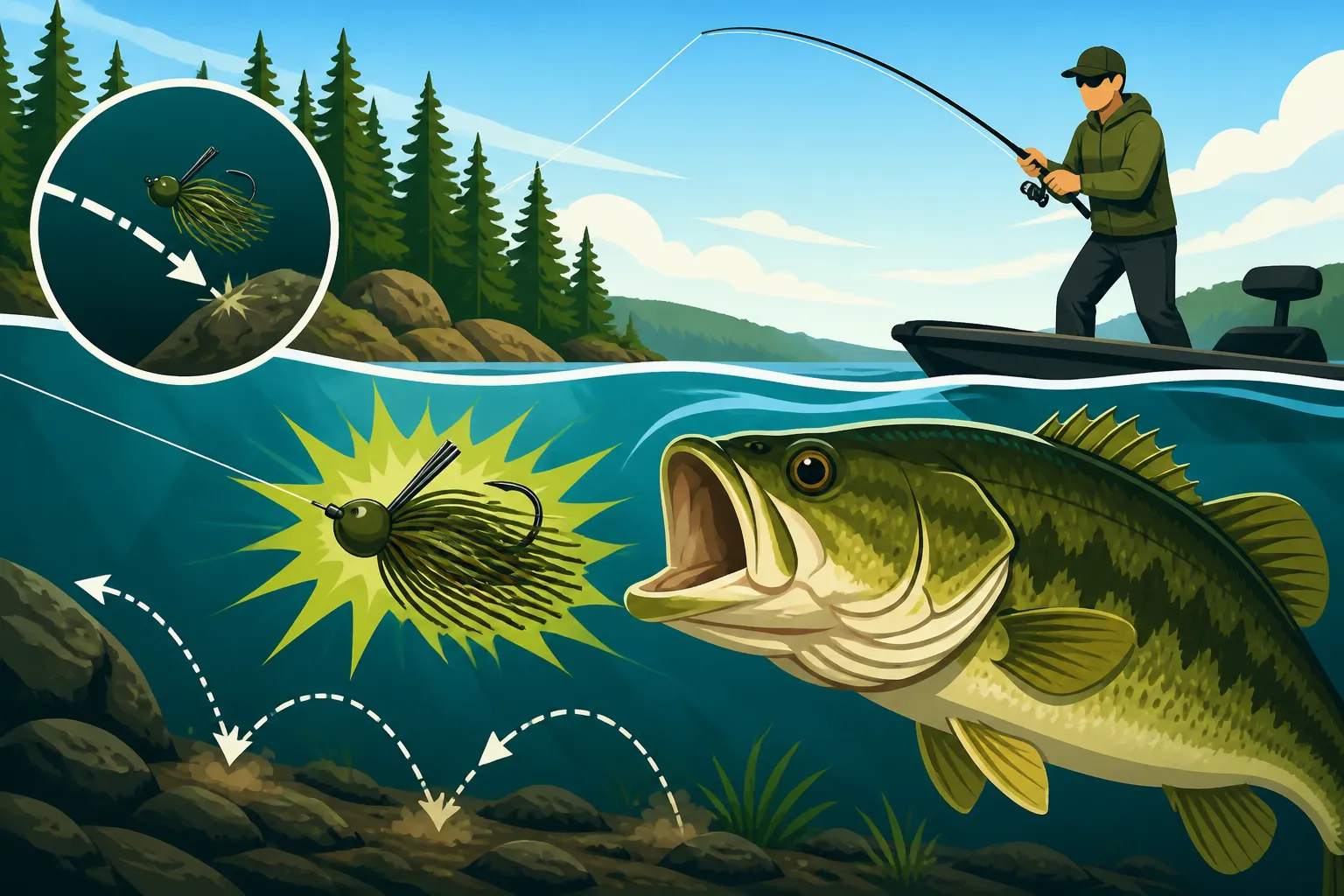
This is where football jigs and Arkie-style jigs truly shine, especially when fishing deeper structure or rocky bottoms. The key here is maintaining constant bottom contact and feeling everything your jig is doing.
-
Dragging: This technique is about slowly pulling your jig along the bottom, mimicking a crawfish foraging.
- Cast: Make a long cast to your target area, letting the jig sink to the bottom on a semi-slack line. Watch your line for any twitch or jump—that's a bite on the fall!
- Slow Pull: Point your rod tip towards the water, engage your reel, and slowly sweep your rod to the side (e.g., from 9 o'clock to 11 o'clock). This pulls the jig along the bottom.
- Reel Down: Drop your rod tip back to the starting position, reeling in the slack line as you do so. This creates a brief pause, during which many bites occur.
- Repeat: Continue this pull-and-pause motion, keeping your jig on the bottom and feeling every rock, log, and subtle change in texture.
-
Hopping: This is a more active presentation, making your jig "hop" or "jump" off the bottom, often mimicking a fleeing crawfish or other prey.
- Cast & Sink: Same as dragging, cast out and let it sink.
- Sharp Hops: Instead of a long sweep, use your wrist to snap the rod tip up sharply, making the jig jump 6-18 inches off the bottom.
- Fall & Pause: Let the jig fall back to the bottom on a controlled slack line. This is a critical moment for bites, so pay close attention. Allow it to sit for a few seconds.
- Repeat: Vary the height of your hops and the length of your pauses until you find what the fish prefer.
Identifying Bites:
- When dragging or hopping, bites can be subtle. It might feel like a "tick," a sudden weight, or simply a feeling of mushiness as your line goes slack prematurely.
- If anything feels "different," set the hook! Bass often inhale jigs, and a strong, sweeping hookset is crucial.
These techniques are particularly effective when fishing the rock piles, humps, and drop-offs found in places like Moosehead Lake or when targeting deeper smallmouth bass in any of Maine's glacial lakes. For more specific location insights, you might want to read our guide on Reading Lake Structure for Maine Bass.
Swimming Jigs: Versatility in Open Water
Swim jigs are the chameleon of the jig family. Unlike bottom-contact jigs, swim jigs are designed to be retrieved through the water column, imitating baitfish, making them an excellent choice for covering water and targeting actively feeding bass.
- The Retrieve: The beauty of a swim jig lies in its simplicity.
- Cast: Make a long cast to your target area, often along weed lines, over submerged grass, or parallel to shore.
- Controlled Retrieve: Immediately begin a steady retrieve, keeping your rod tip slightly elevated. The swim jig should move through the water with a subtle wobble, its skirt and trailer undulating to mimic a swimming baitfish.
- Vary Speed and Depth: Experiment with retrieve speed to find the sweet spot. Sometimes a fast, erratic retrieve triggers strikes; other times, a slow, steady pace is best. You can also vary the depth by letting it sink deeper before starting your retrieve or by pausing briefly to allow it to drop into a pocket.
- Add Twitches: Occasionally, a subtle twitch of the rod tip can make the jig dart or flare, mimicking an injured baitfish and often triggering a reaction strike.
When to use them:
- Swim jigs are fantastic when bass are actively chasing baitfish in open water, along the edges of weed beds, or around submerged timber.
- They are incredibly effective for fishing parallel to shorelines, docks, or rock walls, allowing you to cover a lot of ground quickly.
- They excel in situations where you might otherwise throw a spinnerbait or a bladed jig, offering a slightly different profile and action.
- Think of them when fishing the shallower, weedy coves of lakes known for largemouth bass, or when smallmouth are schooling up on bait in more open water.
- A good swim jig can be a fantastic search bait to locate active fish, especially during the spring and early summer periods in Maine.
Where and When to Fish Jigs for Bass in Maine
Knowing how to fish a jig is only half the battle; knowing where and when to present it can be the difference between a frustrating day and a phenomenal one on Maine's diverse waters.
Targeting Specific Structures and Cover
Maine's lakes and rivers offer a rich tapestry of structures and cover where bass love to hide, ambush prey, and escape the elements. Jigs are designed to get into these places.
- Docks and Pilings: These man-made structures provide shade, cover, and ambush points. Flipping and pitching jigs under and around docks is incredibly effective. Bass often position themselves on the shady side or near the pilings.
- Fallen Trees and Brush Piles: These woody structures are bass magnets. Flipping heavy jigs into the densest parts of submerged timber can yield big fish, but be prepared for snags! This is where strong line and a stout rod pay off.
- Rock Piles and Boulders: Smallmouth bass, in particular, are drawn to rocky bottoms. Football jigs dragged and hopped over rock piles, rocky points, and submerged boulder fields are deadly. The jig's head design helps it crawl over the rocks without snagging excessively. Look for these features on lakes known for smallmouth, like Moosehead Lake or the larger bodies of water in the Rangeley Lakes region.
- Weed Lines and Grass Beds: Both largemouth and smallmouth will relate to the edges of submerged weed beds, coontail, or lily pad fields. Flipping jigs into open pockets within the weeds, or swimming jigs along the edges, can be very productive. Understanding the different types of aquatic vegetation can help you identify prime ambush points.
- Transition Areas: These are spots where one type of cover or bottom composition meets another – for example, where a rocky flat meets a muddy drop-off, or where a weed line ends and open water begins. Bass often stage in these transition zones, using them as highways or feeding lanes. Dragging jigs through these areas can be highly effective. You'll find these vital spots across many of the Best Fishing Lakes in Maine.
Seasonal Strategies for Jigging
Bass behavior, and therefore effective jig presentations, changes dramatically with the seasons in Maine. Adapting your approach is key. You might want to refer to the Maine Fishing Season Dates Guide for broader context.
-
Spring (Pre-Spawn & Spawn):
- Pre-Spawn: As water temperatures rise into the 40s and 50s, bass move from deeper wintering grounds to shallower staging areas. Jigs (especially football jigs) dragged on rocky points, humps, and secondary breaks are excellent for pre-spawn smallmouth. For largemouth, target submerged wood and early-season grass beds with flipping jigs. The goal is a slow, methodical retrieve.
- Spawn: When water temperatures hit the mid-60s, bass move onto beds. While many anglers avoid targeting bedding fish, a jig can be pitched into suspected bedding areas to entice a defensive strike from a territorial bass. Keep your presentations subtle. For more detailed information on spring fishing, check out How to Fish for Smallmouth Bass in Spring.
-
Summer (Post-Spawn & Full Summer):
- Post-Spawn: After spawning, bass often remain shallow for a week or two, recuperating. They can be found in cover or cruising shallow flats. Swim jigs can be great for covering water and finding these active fish.
- Full Summer: As water temperatures peak, bass often seek deeper, cooler water or dense, shady cover.
- Largemouth: Will retreat into the thickest lily pads, matted grass, or fallen timber. Heavy flipping jigs (3/4 oz to 1 oz) are essential to punch through this cover.
- Smallmouth: Will move to offshore humps, rock piles, deep points, and main lake ledges. Football jigs and casting jigs dragged or hopped in 15-30+ feet of water become incredibly effective. Use your electronics to locate these offshore structures and the fish holding to them.
- Night fishing with jigs can also be very productive during summer, as bass move shallower under the cover of darkness.
-
Fall (Feeding Frenzy):
- As water temperatures cool, bass go on a major feeding binge to pack on weight for winter. This is prime time for jig fishing!
- Bass will often move shallower, associating with baitfish that are also moving to warmer, shallower water.
- Jigs can be fished effectively in a variety of ways: dragging football jigs on rock piles, flipping into remaining green vegetation, or even swimming jigs along shorelines. Pay attention to schools of baitfish, as bass will likely be nearby. Many anglers consider fall to be one of the Best Time of Year to Fish in Maine.
Reading the Water for Jigging Opportunities
Being able to "read the water" is an invaluable skill for any angler, and it's particularly important for jig fishing. It involves interpreting visible and invisible cues to locate potential bass holding areas.
- Current: In rivers or lake areas with current, bass will often position themselves just out of the main flow, in current seams or eddies, conserving energy while waiting for prey to be swept by. Pitching jigs into these slack water areas adjacent to current can be highly effective.
- Water Clarity: Clear water often means bass are more wary, and you'll need stealthier presentations and more natural jig colors (green pumpkin, watermelon, brown). In stained or murky water, bass rely more on scent and vibration, so darker, higher-contrast colors (black/blue, black/red) and more aggressive actions can be better.
- Water Temperature: As discussed in seasonal strategies, water temperature dictates bass metabolism and location. Use a thermometer to pinpoint optimal temperature ranges for the species you're targeting. Bass often prefer cooler water in summer and warmer water in spring and fall. Look for thermal breaks or areas where water temperature changes by a few degrees.
- Wind: Wind can be your friend! A choppy surface breaks up the sunlight, making bass feel more secure and less wary. It also creates current and pushes baitfish, concentrating bass on the windy side of points or structures. However, too much wind can make boat control and feeling subtle bites challenging.
- Structure vs. Cover: Remember the distinction: structure is the bottom contour (points, humps, ledges, drop-offs), while cover is what's on the structure (weeds, wood, rocks). Both are critical for bass, and jigs excel at fishing both. Use a good fish finder to locate offshore structure and then target any associated cover with your jig. Learning How to Find Drop-Offs on a New Lake can also be a huge asset.
- Weather Patterns: Bass can be influenced by changes in barometric pressure. Fishing Before a Cold Front can be excellent, as bass often feed aggressively. After a front, they may become lethargic and require slower, more subtle presentations.
By combining an understanding of your jig's components, mastering various presentation techniques, and meticulously reading the water and seasons, you'll transform the humble bass jig into one of your most potent weapons for landing trophy bass across the beautiful waters of Maine. Good luck out there!
| Jig Type | Best Use Cases | Typical Weight Range | Rod Power Recommended | Key Features to Look For |
|---|---|---|---|---|
| Flipping Jig | Dense cover (mats, brush piles, docks), punching | 3/8 oz – 1 oz | Heavy | Compact head, stout weed guard, heavy-duty hook |
| Football Jig | Rocky bottoms, open water humps, deep structure | 1/2 oz – 1.5 oz | Medium-Heavy – Heavy | Wide, football-shaped head, often brush-style weed guard |
| Swim Jig | Covering water, weed lines, open water baitfish mimicry | 1/4 oz – 3/4 oz | Medium-Heavy | Hydrodynamic head, higher line tie, often a thinner skirt |
| Arkie Jig | Versatile, casting, pitching, lighter cover | 1/4 oz – 3/4 oz | Medium-Heavy | Flat bottom, rounded head, good all-around weed guard |
| Finesse Jig | Clear water, pressured fish, sparse cover | 1/8 oz – 3/8 oz | Medium-Light – Medium | Smaller profile, lighter wire hook, more subtle skirt |
Disclaimer
The information provided in this guide is for general informational purposes only and is not intended as legal advice. Fishing regulations, license requirements, and best practices can change. Always consult the official Maine Department of Inland Fisheries and Wildlife (MDIFW) regulations before heading out on the water. Stay safe and fish responsibly.