Maine Nonresident Landowner Fishing License Discount
It can be a real head-scratcher, can't it? You own a beautiful piece of Maine, you pay your taxes, you spend time here, yet when you go to buy a fishing license, you're hit with the significantly higher nonresident rates. It feels a bit unfair, like you're not quite fully integrated into the fabric of the state, even with property ties. But here's some good news: Maine actually offers a special consideration for non-resident landowners, allowing you to access fishing licenses at the same affordable rates as full-time residents. This guide will walk you through exactly how to qualify and take advantage of this often-overlooked benefit.
Who Qualifies for the Maine Nonresident Landowner Fishing License?
Navigating the nuances of residency and land ownership for a fishing license in Maine can feel like trying to untangle a particularly stubborn fishing knot. The state defines "nonresident" pretty clearly when it comes to licenses: if Maine isn't your primary, year-round home, you're generally considered a nonresident. That means you'd typically pay a higher fee for your annual fishing privileges. However, Maine has a thoughtful provision in place for those who've invested in its landscape.
The key to unlocking the resident rate for fishing licenses as a nonresident lies in meeting specific criteria related to your property ownership. It's not just about owning any plot of land; there are precise stipulations you need to meet.
The 25-Acre Rule and Tax Payment Stipulation
To qualify for the resident rate, a nonresident individual must own 25 or more acres of land in the state of Maine. This isn't just a casual ownership; it means you are actively paying real estate taxes on that specific property. The logic here is that if you're contributing to the local tax base, you should enjoy some of the same benefits as a resident, at least when it comes to enjoying Maine's incredible outdoors.
It's important to understand that this isn't a "discount" in the traditional sense; rather, it’s the privilege of purchasing a fishing license at the standard Maine Resident Fishing License Cost. This is a fantastic advantage, especially if you visit Maine frequently or for extended periods throughout the year.
What Counts as Land Ownership for Eligibility
The way your land is owned can impact your eligibility. Generally, the land must be directly owned by the individual seeking the license.
- Individual Ownership: If the deed and tax bill are solely in your name, you're straightforwardly eligible, assuming you meet the acreage and tax payment requirements.
- Joint Ownership: If you own the land jointly with a spouse or other individual, each owner who meets the 25-acre threshold and pays taxes on their portion may be eligible. For instance, if you and your spouse jointly own 50 acres, and both names are on the tax bill, you might both qualify. Always check with the Maine Department of Inland Fisheries and Wildlife (IFW) if there's any ambiguity in your specific joint ownership scenario.
- Corporate or LLC Ownership: This can get a little trickier. Typically, land owned by a corporation, LLC, or trust doesn't automatically confer eligibility to individuals associated with that entity, unless the individual can clearly demonstrate direct ownership and tax payment on 25 acres. If your land is held in a corporate structure, it's absolutely crucial to contact the IFW directly to confirm your eligibility before attempting to purchase your license. This isn't a situation where you want to guess and risk fishing without a valid license.
Remember, the intent is to recognize individual landowners who contribute to Maine's economy through property taxes. So, ensure your ownership structure clearly reflects this.
The Advantage: Accessing Resident License Rates
For many non-residents who cherish their time fishing in Maine, the difference in license costs can be a real sticking point. Nonresident licenses are, understandably, priced higher to reflect that a non-resident isn't contributing to the state's infrastructure and services in the same way a full-time resident does. However, if you're a landowner, Maine acknowledges your contribution and offers a significant financial benefit by allowing you to pay resident rates. This isn't just a small percentage off; it's a complete shift in pricing tier.
Direct Comparison of Nonresident vs. Resident Annual Fishing License Costs
Let's look at some approximate costs to truly grasp the savings. While prices can change, these figures give you a good idea of the difference (current as of early 2024, but always check the official IFW website for the absolute latest rates, which you can often find under their Maine Fishing License Costs Guide).
| License Type | Standard Nonresident Cost (Approx.) | Nonresident Landowner Cost (Approx.) | Resident Cost (Approx.) | Potential Savings (Approx.) |
|---|---|---|---|---|
| Annual Fishing (16+) | $64 – $70 | $25 – $30 | $25 – $30 | $39 – $40 |
| 15-Day Fishing (16+) | $47 – $50 | N/A (Resident 15-day not standard) | N/A (Resident 15-day not standard) | N/A |
| 3-Day Fishing (16+) | $26 – $30 | N/A (Resident 3-day not standard) | N/A (Resident 3-day not standard) | N/A |
| Annual Combination Hunt/Fish (16+) | $110 – $115 | $43 – $48 | $43 – $48 | $67 – $67 |
Note: The "Nonresident Landowner Cost" is equivalent to the "Resident Cost" for applicable license types. Maine residents don't typically have specific 3-day or 15-day fishing licenses, as the annual license is quite affordable.
As you can see, the savings are substantial, particularly for an annual fishing license or a combination hunting and fishing license. For someone who spends several weeks or even months in Maine each year and enjoys hitting the waters multiple times, this effectively pays for itself very quickly. It makes that spontaneous morning trip to the local pond or a planned weekend excursion far more accessible without the added financial burden. This truly encourages Can Out-of-State Anglers Buy a Maine Season License? if they also happen to own land.
Which Licenses Can Be Purchased at Resident Rates?
The ability to purchase at resident rates generally applies to the annual fishing license and combination hunting and fishing licenses. Short-term licenses, such as the Maine 3-Day Nonresident Fishing License or Maine 7-Day Nonresident Fishing License and Maine 15-Day Nonresident Fishing License are specifically designed for visitors who don't have permanent ties or property in the state. Since residents typically opt for the annual license due to its cost-effectiveness, the landowner benefit aligns with purchasing those longer-duration options at the resident price.
If you're a nonresident landowner, you're not just getting a "discount code"; you're essentially being granted the same purchasing power as a full-time resident for the primary annual licenses, a significant gesture that acknowledges your commitment to the state. This is one of the many reasons it's always smart to review the comprehensive Maine Fishing License Guide.
The Application Process: Getting Your Resident-Priced License
So, you're a nonresident, you own 25+ acres in Maine, and you pay real estate taxes on it – fantastic! Now, how do you actually get that resident-priced fishing license? The process is relatively straightforward, but it does require some documentation and attention to detail. This isn't something you can usually just pick up at any convenience store that sells licenses without proving your eligibility first.
Required Documentation for Verification
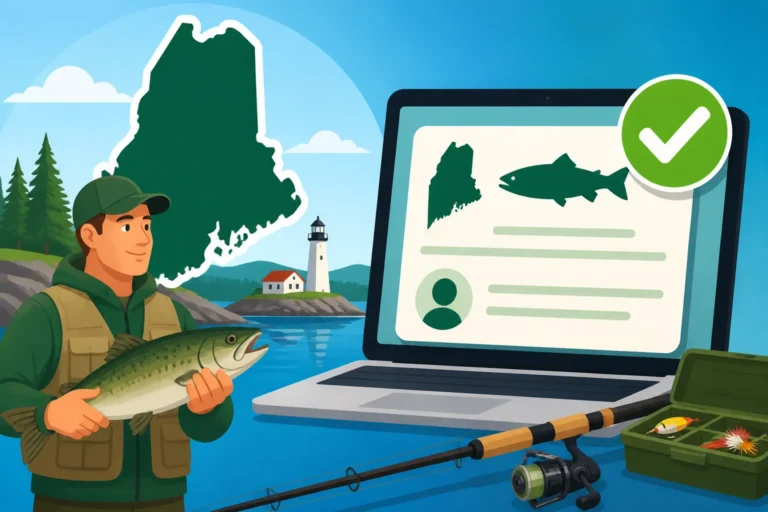
When you apply, you’ll need to prove both your nonresident status and your land ownership in Maine. Here’s what you should have ready:
- Proof of Nonresidency: This is typically your valid state driver's license or other government-issued photo identification from your home state. This document clearly shows that Maine is not your permanent address.
- Proof of Land Ownership: This is the critical piece. You’ll need a copy of your deed to the property or your most recent real estate tax bill from the town or municipality where your 25+ acres are located. The document must clearly show your name, the property address, and indicate the acreage. It also needs to show that you are the taxpayer for that property. Make sure the acreage is clearly listed as 25 acres or more.
- Proof of Tax Payment: While the tax bill itself often implies payment, sometimes further proof (like a receipt or a statement from the town's tax collector) might be requested to confirm that taxes are current. It's best to have a recent, paid tax bill.
Gathering these documents beforehand will make the application process much smoother and prevent any frustrating delays.
Where and How to Apply
Unlike a standard Maine Nonresident Fishing License Cost purchase, which can be done almost anywhere, applying for the nonresident landowner resident-priced license typically requires a bit more interaction to verify your eligibility.
- Online via the IFW Website (Potentially with Prior Setup): The Maine Department of Inland Fisheries and Wildlife (IFW) website is the official portal for license purchases. While you can technically buy licenses online, for your initial nonresident landowner license at resident rates, you might need to first establish your eligibility with the IFW. This could involve sending in your documentation or contacting them directly to have your account flagged as eligible. Once approved, subsequent renewals might be simpler online. It's always best to check the IFW website for their most current instructions on this specific application process.
- In-Person at an Authorized IFW Agent or Regional Office: This is often the most reliable way to get your initial nonresident landowner license, as you can present your documents directly. While you can find a list of Where to Buy a Maine Fishing License agents on the IFW website, not all agents may be equipped or authorized to process this specific type of verification on the spot. Your best bet for in-person application might be a larger sporting goods store that is a well-established agent, or even better, one of the regional IFW offices. They deal with these unique situations regularly and can guide you through the process, ensuring all your ducks are in a row.
Tips for a Smooth Application
- Call Ahead: Before you make a trip, especially to an agent or regional office, call the IFW or the specific agent to confirm their process for nonresident landowners. This can save you a wasted journey.
- Bring Copies AND Originals: While copies of your deed or tax bill are usually sufficient, having the originals on hand as backup can prevent any issues if a clerk wants to verify authenticity.
- Be Patient: The verification process might take a little longer than a standard license purchase, especially if you're doing it for the first time. The staff are just ensuring all regulations are met.
- Keep Records: Once you have your license, keep a copy of the documents you used for application. This will make renewals easier in subsequent years, particularly if you renew online. You might even find helpful guides or regulatory updates for anglers if you search on Amazon for Maine fishing books or maps.
By following these steps, you'll soon be enjoying Maine's fantastic fishing opportunities with the peace of mind that you've secured your license at the appropriate, resident-level rate. For more detailed information on obtaining licenses, be sure to read our guide on How to Get a Maine Fishing License.
Understanding Your Responsibilities as a Landowning Angler
Having the privilege of purchasing a Maine fishing license at resident rates as a nonresident landowner is a fantastic perk. It acknowledges your investment in the state and its communities. However, with privilege comes responsibility. Your status as a landowner does not exempt you from any of the state's comprehensive fishing regulations. In fact, it should encourage an even deeper commitment to ethical angling and conservation.
Adhering to All Maine Fishing Regulations Explained
Just like any other angler on Maine's beautiful lakes, rivers, and coastal waters, you are required to know and follow all the rules. This includes, but isn't limited to:
- Maine Fishing Regulations Explained: These cover everything from legal fishing methods to specific rules for different bodies of water. Maine has a complex system of general law waters and special regulation waters, often with very specific rules for individual lakes or ponds.
- Maine Fish Bag Limits Guide: You'll need to know the daily and possession limits for species like brook trout, landlocked salmon, togue, and bass. These limits are in place to ensure sustainable fish populations for future generations.
- Maine Fishing Season Dates Guide: Fishing seasons vary by species and by location. What might be open year-round in one area could have specific closure dates or catch-and-release only periods in another. Always consult the latest law book or the IFW website.
- Length and Size Limits: Many species have minimum or maximum length requirements. For example, striped bass have a specific slot limit. Keeping an undersized or oversized fish is a violation.
It's a good idea to always carry a current copy of the Maine Open Water and Ice Fishing Laws. You can pick up a physical copy at most license agents, or download a digital version from the IFW website. Sometimes, you can even find handy pocket guides or waterproof regulation summaries on sites like Amazon, which can be invaluable out on the water.
Ethical Angling and Conservation
As a landowner, you have a vested interest in the health of Maine's natural resources. This extends to practicing responsible angling:
- Catch and Release Practices: When practicing catch and release, handle fish gently, minimize their time out of water, and ensure they are revived before release. This is particularly important for sensitive species or in waters where conservation is a priority.
- Preventing the Spread of Invasive Species: Always clean, drain, and dry your boat, trailer, and fishing gear between different bodies of water. Invasive plants and animals pose a serious threat to Maine's aquatic ecosystems.
- Respecting Private Property: Even though you own land, remember that many other shorelines are private property. Be mindful of where you launch, fish, and access water, and always obtain permission before crossing or fishing from private land that isn't yours.
- Reporting Violations: If you observe poaching or other illegal fishing activities, don't hesitate to report them to the Maine Warden Service. Protecting Maine's fisheries is a collective effort.
Your status as a nonresident landowner signifies a deeper connection to Maine. By understanding and upholding all Maine Fishing Laws for Beginners and advanced anglers alike, you contribute positively to the conservation efforts that make Maine such a world-class fishing destination. It's a small price to pay for the incredible experiences Maine offers.
Disclaimer
The information provided in this guide is intended for general informational purposes only and does not constitute legal advice. Fishing regulations and license requirements in Maine are subject to change. Always consult the official Maine Department of Inland Fisheries and Wildlife (IFW) website or their printed law book for the most current and accurate information before planning your fishing trip or purchasing a license. Specific eligibility for nonresident landowner licenses should always be confirmed directly with the IFW.