Maine Freshwater vs Saltwater License Differences
It can be incredibly confusing trying to figure out what licenses and registrations you need to fish in Maine, especially with our incredible diversity of fishing spots. Are you heading to a serene inland lake for brook trout, or are you dreaming of battling striped bass along the rugged coast? Many anglers get caught up wondering if a single permit covers everything. This guide is here to untangle the nuances of Maine's freshwater and saltwater fishing requirements, making sure you're legally prepared for your next adventure.
Understanding Maine's Freshwater Fishing License
When most people think of a "fishing license" in Maine, they're usually picturing the freshwater one. This is the bread and butter for anyone planning to cast a line in our beautiful inland waters, and it’s a strict requirement for almost everyone.
What Waters a Freshwater License Covers
Your Maine freshwater fishing license is your golden ticket to literally thousands of lakes, ponds, rivers, and streams across the state. Think of the vast expanse of Moosehead Lake, the pristine waters of the Rangeley Lakes region, or the meandering flow of the upper Penobscot River. These are all firmly in freshwater territory. If the water isn't directly influenced by ocean tides and salinity, you're almost certainly in freshwater.
These are the domains where you’ll find classic Maine game fish like landlocked salmon, a variety of trout species (brook trout, brown trout, and lake trout, which we fondly call togue), and both smallmouth and largemouth bass. Even if you're just dipping a worm in a small farm pond for sunfish, if it's not tidal, you need that freshwater license. The definition is pretty straightforward: if it's not ocean or directly connected tidal water, it's freshwater.
Who Needs a Freshwater License
Generally speaking, if you're 16 years of age or older and planning to fish in Maine's inland waters, you absolutely need a freshwater fishing license. This applies whether you're a lifelong Maine resident or visiting from out of state.
However, there are a few important exceptions to be aware of. Children under the age of 16 are typically exempt from needing a freshwater license. Additionally, Maine offers special opportunities like Maine Free Fishing Days Guide where residents and non-residents can fish without a license for a specific period, usually a weekend in winter and another in summer. Certain individuals, like registered Maine guides acting in the capacity of a guide, also have specific rules. It’s always best to check the official guidelines for Maine Fishing License Age Requirements in Maine and Maine Fishing License Exemptions to be sure you qualify for any waivers. Keep in mind that even if you're exempt from the license requirement, you still need to follow all other fishing regulations, including bag limits and length restrictions for specific species.
The cost of a freshwater license varies depending on whether you're a resident or non-resident, and the duration you choose. Options range from 1-day, 3-day, 7-day, 15-day, to a full season license. Planning your trip duration is key to picking the most economical option.
How to Obtain Your Freshwater License
Getting your Maine freshwater fishing license is thankfully a pretty straightforward process these days. You have a couple of main avenues:
- Online: This is by far the most convenient method for many. The Maine Department of Inland Fisheries and Wildlife (MDIFW) website allows you to purchase and print your license from the comfort of your home. It’s quick, efficient, and ensures you have your license before you even hit the road. If you're wondering How to Buy a Maine Fishing License Online, you'll find the process quite user-friendly. You'll typically need to provide some personal identification information, such as your driver's license number.
- In-Person Agents: For those who prefer a face-to-face transaction or need a license on the fly, you can purchase one from various licensed agents across the state. These agents are typically sporting goods stores (like your local L.L.Bean or independent outfitters), convenience stores, and many town clerk offices. This can be particularly useful if you're already on your trip and realize you forgot to get one. Many anglers enjoy the tradition of stopping at a local general store to grab their license and some last-minute bait. To find a location near your destination, check out resources on Where to Buy a Maine Fishing License In Person.
Always make sure to carry proof of your license while fishing, whether it's a physical printout or a digital copy on your phone. Game wardens regularly check for compliance, and it’s best to be prepared.
Navigating Maine's Saltwater Fishing Registry (Not a License!)
This is where the biggest source of confusion often lies for anglers heading to Maine's coast. Unlike many other states, Maine does not issue a traditional "saltwater fishing license." Instead, it requires anglers to register with the state for saltwater fishing.
The Distinction: Registry vs. License
Let's be absolutely clear: Maine operates a Saltwater Fishing Registry, not a saltwater fishing license. This is a critical distinction. A license typically involves a fee and a physical document, while Maine's registry is a no-cost registration process, primarily driven by federal mandates. The National Marine Fisheries Service (NMFS) requires coastal states to have a system in place to collect data on saltwater recreational anglers for better fisheries management and conservation efforts.
So, while you might hear people colloquially refer to it as a "saltwater license," remember it's a registration. This means no fee for the registration itself, but it’s still legally required for most individuals casting lines in Maine's marine waters. Failing to register can still lead to penalties, just like fishing without a freshwater license. Understanding the Maine Saltwater Fishing Registry Guide is crucial for coastal anglers.
What Waters the Saltwater Registry Covers
Your saltwater fishing registry covers all of Maine's marine waters. This includes the vast expanse of the Atlantic Ocean along our coastline, iconic bays like Casco Bay and Frenchman Bay, and estuaries and tidal rivers where freshwater meets the sea. Essentially, if the water is salty or subject to tidal influence, even if it's upstream in a river, the saltwater registry applies.
These are the prime hunting grounds for species like the highly sought-after striped bass, mackerel, bluefish, flounder, and various groundfish. Whether you're casting from a rocky shore, wading a tidal flat, or fishing from a boat a few miles offshore, if you're targeting saltwater species in saltwater, this is your required credential. The distinction between saltwater and freshwater can get tricky in the lower stretches of rivers where the tide still pushes, and we'll delve into that more soon. If you're specifically targeting migratory species like Maine Striped Bass Season and Limits, this is what you'll need.
Who Needs to Register for Saltwater Fishing
Similar to freshwater, there are requirements and exemptions for the saltwater fishing registry. Generally, if you are 16 years of age or older and planning to fish recreationally for finfish in Maine's saltwater, you need to register. This applies to both residents and non-residents.
However, several exemptions exist to prevent redundant registration:
- Under 16: Anglers under 16 years of age do not need to register.
- Charter Boat Passengers: If you are fishing aboard a properly licensed for-hire vessel (like a charter boat or head boat) that has already obtained a federal Highly Migratory Species (HMS) permit or a state commercial vessel permit, you typically do not need your own individual registry. The vessel's permit covers you.
- Other State Licenses: If you possess a valid recreational saltwater fishing license from another state that is currently recognized by Maine as having reciprocal registration (meaning they share angler data), you may also be exempt. This is a common arrangement among coastal states.
- Federally Licensed Anglers: If you hold a federal marine recreational fishing permit, you may also be exempt.
It's important to verify the latest Saltwater Fishing Registry Cost and Requirements and specifically whether Do I Need a Saltwater License to Fish From a Maine Pier? or other specific scenarios apply to you, as rules can change. When in doubt, it’s always better to register; it’s free and quick.
How to Complete Your Saltwater Registration
Completing your Maine saltwater fishing registration is simple and free, which is a relief! The primary method is online:
- Online via MDIFW: The Maine Department of Inland Fisheries and Wildlife (MDIFW) website provides a dedicated portal for the saltwater registration. You'll typically fill out a short form with your basic personal information. Once submitted, you'll receive a confirmation number. While you generally don't get a physical card, it's a good idea to print out this confirmation or save it on your phone. This confirmation number is your proof of registration and should be available if a Marine Patrol Officer asks for it. The process takes mere minutes and ensures you're compliant.
There aren't typically in-person agents for the saltwater registry like there are for freshwater licenses, as the system is designed to be purely digital and free of charge.
Key Differences and Overlapping Waters
Now that we've covered the individual requirements, let's look at the crucial distinctions and address the trickiest part: fishing in waters that seem to blur the line between fresh and salt.
Freshwater vs. Saltwater: The Hard Lines
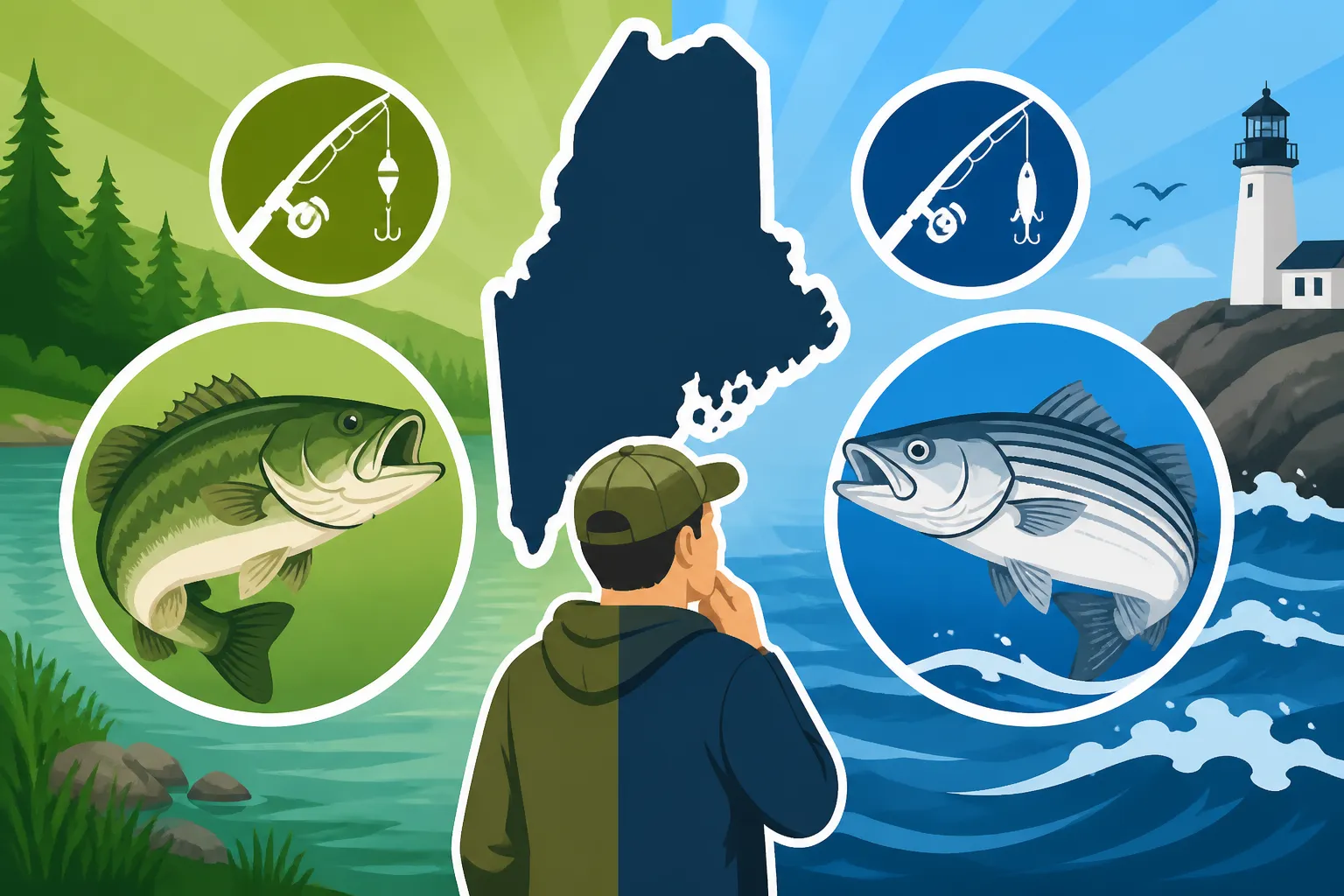
The most fundamental difference is that your Maine freshwater fishing license is valid only for non-tidal, inland waters. It will not suffice for fishing in the ocean, bays, or tidal rivers. Conversely, your Maine saltwater fishing registry is valid only for tidal, marine waters and does not allow you to fish in inland lakes, ponds, or non-tidal river sections. You absolutely cannot use one in place of the other.
This table highlights the core distinctions:
| Feature | Maine Freshwater Fishing License | Maine Saltwater Fishing Registry |
|---|---|---|
| Required For | Fishing in inland lakes, ponds, rivers, streams (non-tidal) | Fishing in ocean, bays, tidal rivers, estuaries (tidal) |
| Cost | Varies (resident/non-resident, duration) | FREE |
| Issued By | MDIFW | MDIFW (federal mandate) |
| Proof Required | Physical license or digital copy | Confirmation number (print or digital) |
| Primary Species | Trout, Salmon, Bass, Perch, Pickerel | Striped Bass, Mackerel, Bluefish, Groundfish |
| Validity | Calendar year (Jan 1 – Dec 31) | Calendar year (Jan 1 – Dec 31) |
| Can Be Used for Other? | NO | NO |
If you're planning a trip that involves both inland lake fishing and a day of striper fishing on the coast, you'll need both a freshwater license and to complete the saltwater registry. There's no single "combo" option that covers everything for free.
Understanding Tidal Rivers and Estuaries
This is undoubtedly the most confusing aspect for many anglers. Maine has numerous rivers, like the Kennebec, Penobscot, and Saco, that transition from freshwater further inland to tidal saltwater as they approach the ocean. So, Is a Freshwater License Enough for Maine Rivers?. The answer is, it depends on where you are on that river.
The general rule is that if the water is subject to tidal influence, even if it might taste relatively fresh during a low-tide outflow, it's considered saltwater for licensing purposes. The MDIFW often defines a "freshwater line" or "head of tide" for specific rivers. Upstream of this line, you need a freshwater license. Downstream of this line, you need the saltwater registry. This line isn't always obvious to the casual observer, especially if you're new to an area.
Example Scenario: Imagine you're fishing the Kennebec River. If you're way up near Augusta, you're firmly in freshwater territory, needing a freshwater license to target bass or trout. However, if you're down near Bath or Phippsburg, where the river mouth meets the ocean, it's undoubtedly saltwater, and you'd need the saltwater registry for striped bass. The tricky part is in between. Many maps or local signage might indicate the freshwater line, but it’s always best to consult the current Maine Fishing Regulations Explained for the specific body of water you intend to fish. These regulations provide detailed maps and descriptions for these transitional zones.
The "Combined" Scenario and Best Practices
For many enthusiastic anglers, a trip to Maine might involve trying to catch both a feisty landlocked salmon in a mountain lake and a powerful striped bass in the ocean. In such cases, there’s no getting around it: you will need to purchase a freshwater fishing license and complete the free saltwater fishing registry.
Here are some best practices to ensure you're covered:
- Plan Ahead: Before your trip, identify all the waters you plan to fish and the species you'll target. This will clarify your credential needs.
- Check Regulations Thoroughly: Always, always check the current Maine fishing law book or the MDIFW website for specific regulations for each body of water you plan to fish. Special regulations often override general laws, especially in popular lakes or tidal zones.
- Carry Proof: Whether digital or physical, always have proof of your freshwater license and saltwater registration readily available. Game Wardens and Marine Patrol Officers will ask for them.
- When in Doubt, Register/License Up: Since the saltwater registry is free, there’s no reason not to complete it if there’s even a slight chance you’ll be in tidal waters. For freshwater, err on the side of caution and get the appropriate license. It’s a small investment for peace of mind and to avoid potential fines.
Penalties for Non-Compliance
It's easy to think, "What's the big deal if I forget one little piece of paper?" But in Maine, fishing without the proper license or registration is taken seriously by law enforcement officials.
What Happens If You Fish Without the Right Credentials
Fishing without a valid freshwater license or without having completed the saltwater registry can lead to a range of unpleasant consequences. The Maine Department of Inland Fisheries and Wildlife (MDIFW) and the Maine Marine Patrol actively enforce these regulations to protect our fisheries and ensure fair play.
Here's what you could face:
- Fines: The most common penalty is a monetary fine. These fines can vary depending on the specific offense, whether it's a first-time violation, and the discretion of the warden, but they are never insignificant. You'll quickly realize that the cost of a license or the few minutes it takes to register is far less than the fine you'd pay. Information on Maine Fishing License Fine for No License can give you an idea of the costs involved.
- Confiscation of Gear: In some cases, particularly for repeat offenders or serious violations, your fishing equipment (rods, reels, tackle) could be seized. This is a tough lesson to learn for any angler.
- Loss of Fishing Privileges: A conviction for fishing without a license could also result in the suspension of your fishing privileges for a period, not just in Maine but potentially in other states with reciprocal agreements.
- Criminal Record: While often a civil infraction, severe cases or repeat offenses could escalate to a misdemeanor, which would result in a criminal record.
The wardens and patrol officers aren't out to ruin your day, but they are dedicated to conservation and ensuring that everyone abides by the rules. Their job is to protect Maine's natural resources for everyone to enjoy responsibly. Explaining that you "didn't know" or "forgot" is rarely an acceptable excuse in the eyes of the law. If you're caught Fishing Without a License in Maine, it can put a significant damper on your trip.
Final Thoughts and Planning Your Maine Adventure
Maine truly offers a fishing experience like no other, from the remote trout ponds of the North Woods to the thrilling striped bass runs along our spectacular coast. But to fully enjoy it, a little preparation goes a long way, especially when it comes to understanding our unique licensing and registration requirements.
Don't let the subtle differences between a "license" and a "registry" trip you up. Always assume you need a freshwater license for inland waters and complete the free saltwater registry for coastal fishing, especially if you plan to explore both worlds. The slight effort it takes to get these in order is a small price to pay for the incredible angling opportunities that await you.
By being informed, compliant, and respectful of our natural resources, you're not just ensuring a smooth trip for yourself, but you're also contributing to the ongoing health and abundance of Maine's incredible fish populations for generations to come. Tight lines, and may your Maine fishing adventures be memorable and legal!
Disclaimer
The information provided in this guide is for general informational purposes only and is not intended as legal advice. Fishing regulations in Maine can change, and special rules may apply to specific bodies of water or species. Always consult the most current official Maine Department of Inland Fisheries and Wildlife (MDIFW) regulations and the Maine Marine Patrol for the most accurate and up-to-date information before planning your fishing trip.